Zeus: The Olympian Tyrant and the Mythological Necessity of Chaos
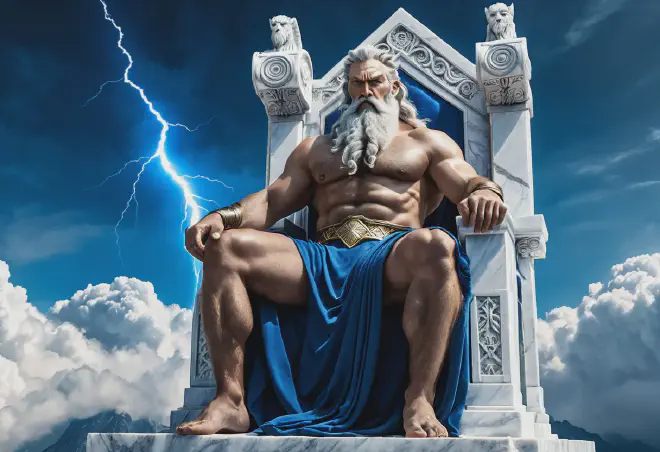
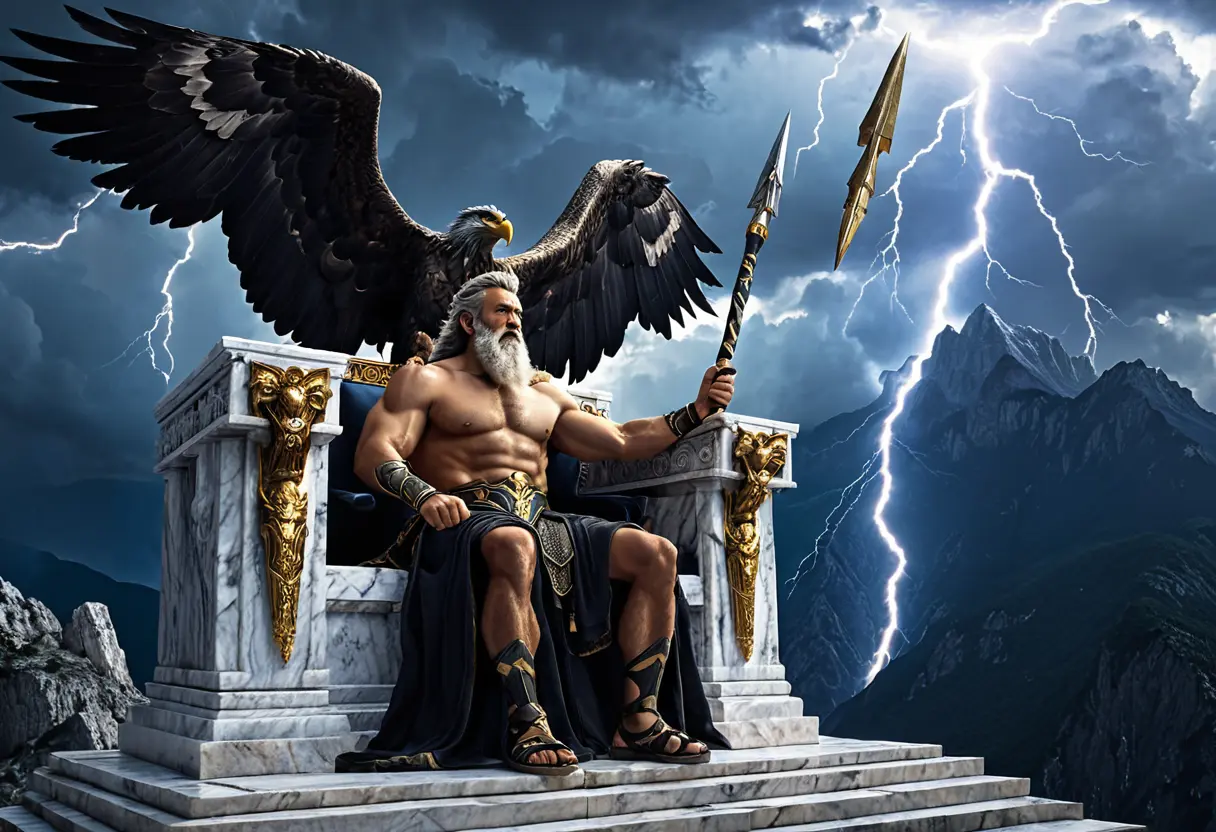
The Path to Hegemony: The Father-Eater and the Great War
Zeus was born into a cycle of domestic horror. His father, the Titan Cronus, feared a prophecy that his children would overthrow him, so he swallowed them one by one at birth. Zeus was the only one saved, hidden in a cave on Crete while his father swallowed a stone in his stead.
Upon reaching maturity, Zeus returned not as a savior, but as a revolutionary. He forced Cronus to disgorge his siblings—Hera, Poseidon, Hades, Hestia, and Demeter—and led them in a ten-year apocalyptic war against the Titans known as the Titanomachy . This was more than a battle for power; it was a fundamental shift in the universe’s frequency: from the raw, primordial chaos of the Titans to the structured, albeit volatile, order of the Olympians.
With the victory, Zeus claimed the sky by drawing lots. From that moment, the world was governed by his Keraunos (Thunderbolt) —as a weapon capable of shattering mountains and boiling the seas, it served as the physical manifestation of his ultimate legal authority.
The Progenitor of Myth: Infidelity as a Necessary Evil
The most frequently discussed aspect of Zeus’s character is his staggering number of affairs and illegitimate children. While modern perspectives often view this as mere scandal, from a mythological and historical standpoint, Zeus’s infidelity was a structural necessity .
He was the “Breeder of Heroes.” By spreading his seed across the mortal world, Zeus acted as a catalyst to transition humanity from the primitive age into the Age of Heroes . The great legends—Heracles, Perseus, Minos—were all “Sons of Zeus.” For the ancient Greek polis (city-states), claiming a bloodline to Zeus was the only legitimate foundation for political authority and military prowess. He didn’t just philander; he populated the civilization of man with the divine sparks needed to lead it.
The Shifting Sovereign: The Magic of Metamorphosis
Zeus was the master of the “hidden form.” He rarely approached his targets as a god, instead choosing to bypass physical and mental barriers through metamorphosis: *The Swan : To seduce Leda, appearing as a creature of grace. *The Golden Rain : To reach Danaë in her subterranean prison, bypassing a king’s locks by becoming light itself. *The White Bull : To carry the princess Europa across the sea, hiding his terrifying power behind a gentle, majestic facade.
These transformations reflect the ancient Greek view of nature: that every cloud, every animal, and every sudden storm might be a mask for the supreme will of the universe.

Zeus Xenios: The Guardian of the Threshold
Beyond his passions, Zeus held a severe and non-negotiable role as Zeus Xenios —the protector of guests and travelers. The law of Xenia (hospitality) was the highest moral code in the Greek world. To mistreat a traveler or a guest was to invite the direct wrath of the Thunderbolt.
This aspect shows the “Order” side of his nature; he was the one who ensured that civilization could function even among strangers. He was the guarantor that the boundaries between people, like the boundaries between gods, were observed and respected.
Zeus is the supreme paradox: a lawgiver who broke his own vows, a cold judge who burned with mortal desire. He is the mirror of the sky itself—sometimes clear and guiding, sometimes a roiling vortex of destructive lightning. To understand Zeus is to understand the Greek realization that power, in its purest form, is neither good nor evil; it is simply absolute.