Kuchisake-onna: The Slit-Mouthed Woman - Japan’s First Analog Pandemic

The year was 1979.
In an era without the internet or social media, a phenomenon occurred that literalized terror for every child in Japan. This was the reign of the Kuchisake-onna (The Slit-Mouthed Woman) .
What started as a whispered rumor in a rural area of Gifu Prefecture traversed the entire island nation in just a few months. It triggered police patrols and forced schools to organize group walk-homes—a massive System Overload of the national security and education sectors. She demonstrated an “infection rate” that rivals even the most explosive modern SNS viral trends. She was more than a ghost; she was the first “Information Pandemic” of the post-war era.

1. The Mechanics of Contagion: The “Information Highway” of Cram Schools
In terms of transmission speed, the Kuchisake-onna set legendary records for the analog world. The rumor jumped from school to school via lunch breaks and parks, but it reached national saturation through a specific relay: the “Juku” (Cram Schools) .
In the late 70s, Japan’s educational facilities were booming. Children who otherwise remained in their local districts were now mixing with students from far-flung areas at these night schools. The Juku acted as physical “retweets,” allowing the legend to jump geographic boundaries at unprecedented speeds. This physical networking for the sake of “education” became the very foundation of the terror’s mobility.
2. Profile of a Threat: The “Double Bind” Trap
The terror of the Slit-Mouthed Woman is concentrated in her psychological trap—the “Double Bind.” | Element | Feature | Psychological Metaphor |
| :— | :— | :— |
| The Question | “Am I pretty?” | Forced submission to an inescapable, external judgment. |
| Mobility | 100 meters in 3 seconds | The total denial of physical escape in an urban setting. |
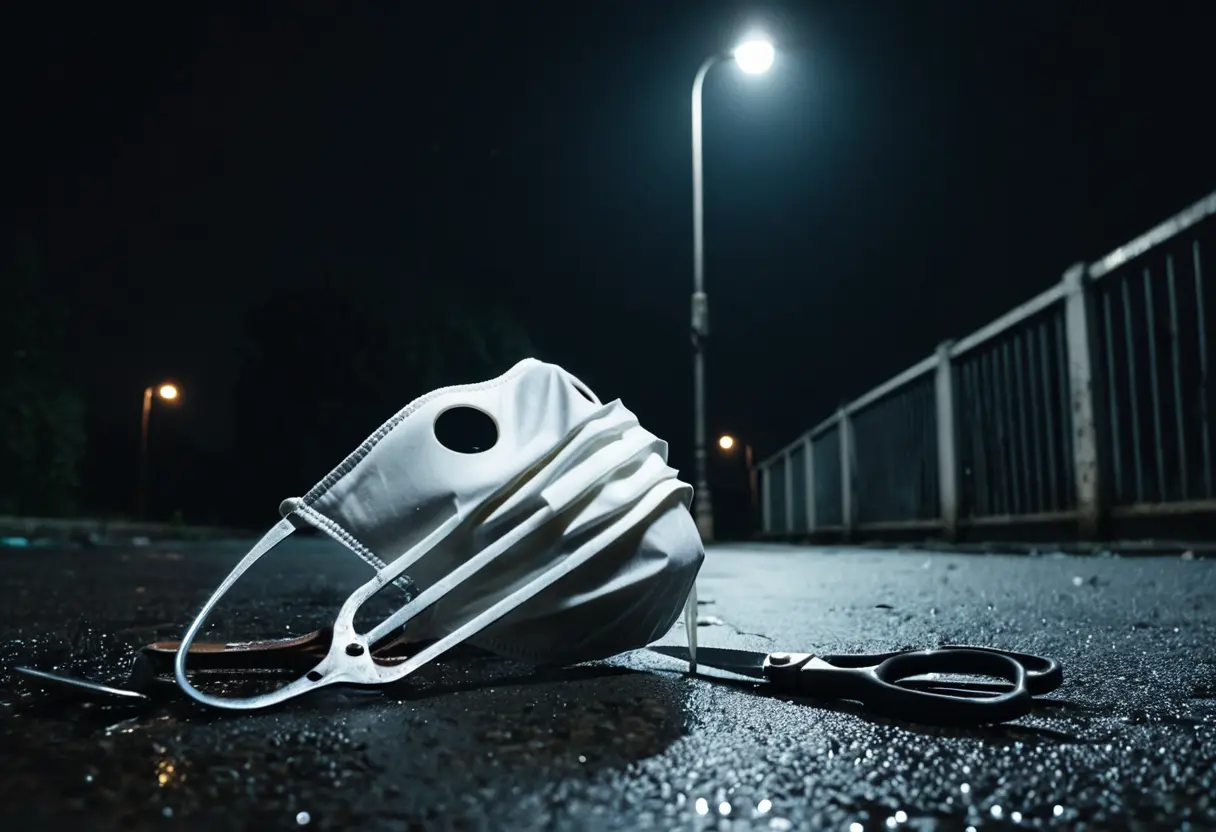
| Weapon | Tailoring scissors | The violation of life using mundane, household tools. |
| The Outcome | Affirmation or Denial | Despair where both “Yes” and “No” lead to a violent “Equalization.” |
Countermeasures like chanting “Pomade” or offering Bekko-ame (amber candy) were “survival strategies” desperately engineered by children to find a loophole in her invincible logic—much like the spiritual interventions explored in the Yuta of Okinawa .
3. The Social Shadow: The Ghost of the “Education Mama”
What was the true nature of this phantom? It can be argued she was a grotesque projection of the “Kyoiku Mama” (Education Mama) —a societal phenomenon of competitive meritocracy.
The Relentless Pursuit : Her ability to run at 100 km/h symbolized the claustrophobia of children tracked from school to cram school, never escaping adult surveillance.
The Achilles’ Heel (Pomade) : In that era, “Pomade” was synonymous with the smell of the strict, traditional father. Only the father had the authority to restrain the mother’s obsessive focus on education—hence the legend that she “hates” the smell.
The Physical Distortion : The slit mouth reflects the “suffocation” of the child’s identity, a motif later echoed in myths like Skin Respiration , where the biological self is sacrificed for a superficial ideal.
Closing: The Red Coat in the Digital Twilight
The woman in the red coat was not just a ghost. She was a tragic “avatar of discipline,” born from children robbed of their “safe darkness” by adult expectations.
Today, while the red coat has faded, the “Social Virus” she represented has evolved. The forced labor and loss of self found in the Tuna Boat legends are the modern descendants of the Slit-Mouthed Woman’s pursuit. She reminds us that when society becomes a trap, the monsters we create will always have the fastest legs.
Jinmenken: The Human-Faced Dog : The beast born from the Bubble Era’s consumption culture.
Skin Respiration: The Suffocation Myth : Exploring the physical price of urban legends.
The Tuna Boat Trap: Modern Disappearance : How the fear of pursuit has evolved into economic dread.