The Daruma Woman: The Black Box of the Dressing Room
1. The Black Box: When the Protocol Fails
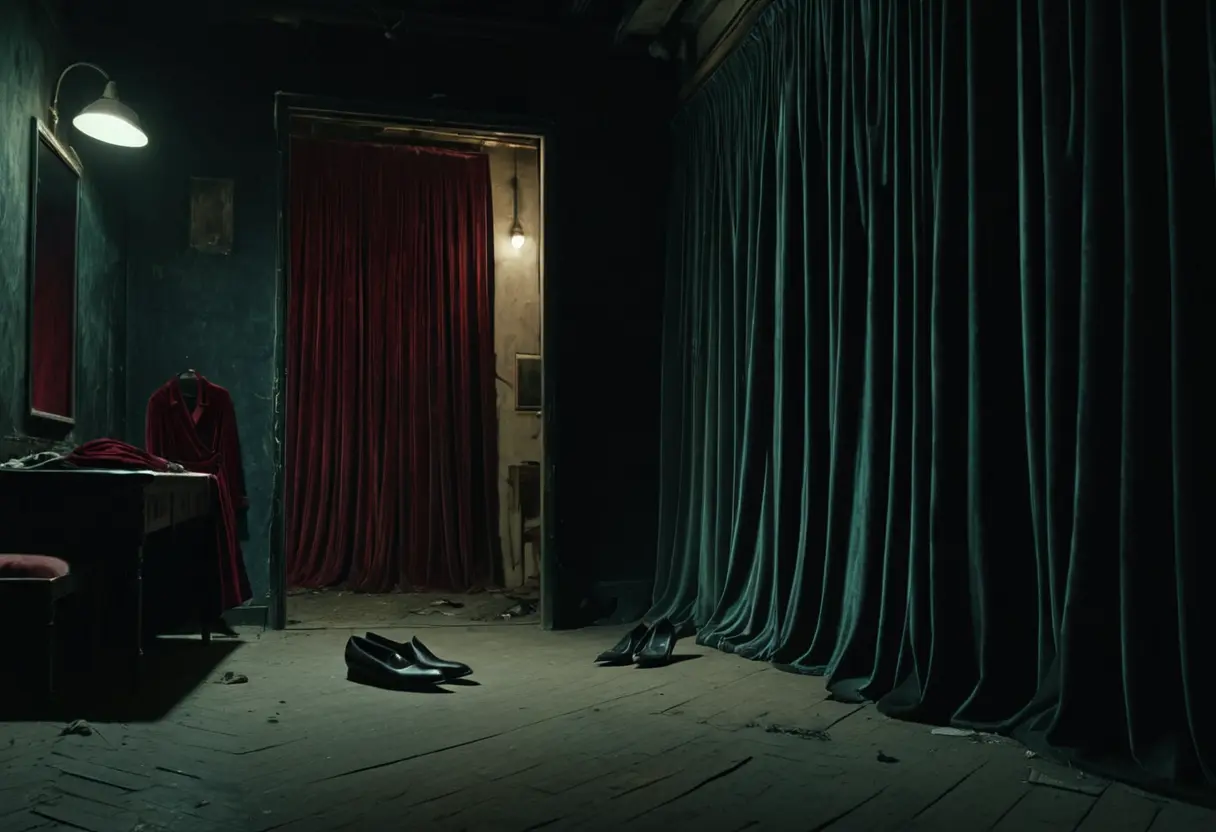
The dressing room is a unique urban space: a Public Exterior with a Private Interior . For a few minutes, you are entirely disconnected from the world’s surveillance.
In the legend, the wife enters the booth, and the husband waits outside. The “Protocol of Shopping” suggests she will re-emerge in a moment. But the curtain remains still. When the husband finally enters, the space is empty. There is no hidden door, no struggle. Just a Deletion in Local Space .
This is the horror of the “Black Box.” It exploits the anxiety that our physical presence is not a permanent data point, but a fragile status that can be “Uninstalled” by a hostile environment.
2. The Body Horror: The Ultimate Equalization
Years later, the husband finds his wife in a “Freak Show” or a dark alley. She is no longer recognizable. Her limbs are gone, her tongue is cut—she has been transformed into a “Daruma” (a Japanese traditional doll with no limbs).
This is the ultimate Physical Devaluation . Through kidnapping and forced mutilation, a “Person” is stripped of their agency and converted into a “Material” for the entertainment or profit of others. It mirrors the ancient historical accounts of “Human Pigs” (Ren-Zhu), resurfacing as a modern-day warning against the “Dark Markets” of the world.
3. The Root Code: Xenophobia and the “Orléans Rumor”
The Daruma Woman legend is deeply rooted in Xenophobia (Fear of the Foreign) .
It gained massive traction in Japan during the hyper-growth bubble era when overseas travel became common. It functioned as a “Psychological Firewall,” a warning that the “Other” is cruel and unfathomable.
Historically, this shares a core with the “Orléans Rumor” of 1969 France, where rumors spread that Jewish-owned boutiques were kidnapping women via dressing rooms. Whether in France or Japan, the legend serves to project internal social anxieties onto an external scapegoat, using a “Black Box” (the fitting room) as the vector for a collective panic.
Conclusion: The Vulnerability of the Traveler
The Daruma Woman reminds us that “Safety” is a temporary consensus. For the traveler, every unknown door and every private curtain is a risk.
The story asks: in a world where we can track our smartphones across the globe, how can a human being still be “Lost to the System” in an instant? The answer lies behind the curtain, in the spaces where the world’s oversight still fails to reach.
*Kuchisake-onna: The First Social Pandemic : The evolution of urban suspicion. *The Anatomy of Body Horror : Why we fear the loss of our physical form. *The Tuna Boat Trap: Economic Kidnapping : The modern, economic version of “disappearing.”