Turbo Granny: The 140km/h Pursuer and the Terror of Inevitability

Midnight on the expressway. You are cruising at the limit—100km/h. Suddenly, your rearview mirror catches a flicker of something that shouldn’t be there.
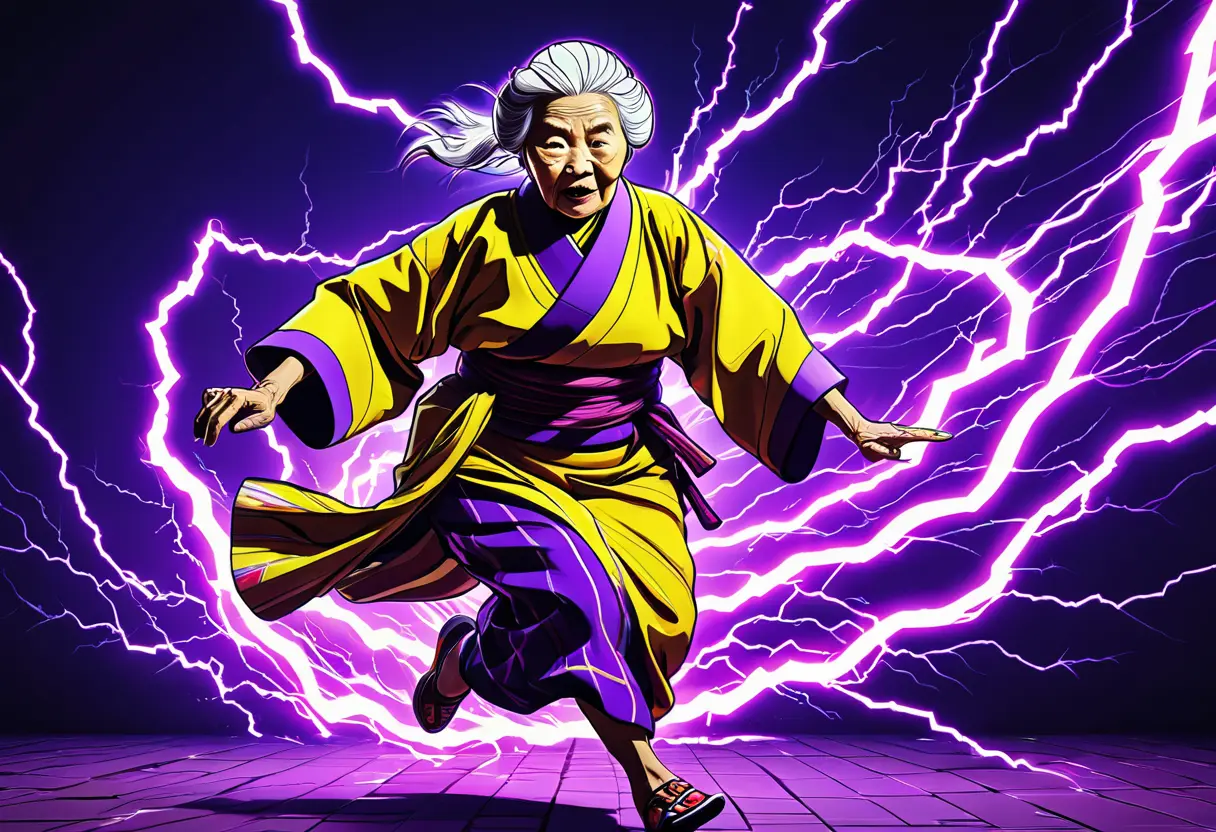
A small, elderly woman is silently closing the gap. She pulls up alongside your car on the right lane, her hunched back tilted forward against the wind. For a moment, she locks eyes with you, flashes a sinister, knowing grin, and then—accelerating to over 140km/h—she disappears into the darkness ahead, leaving your engine screaming in her wake.
This is Turbo Granny , Japan’s fastest urban legend.

1. Evolution of the Predator: Jet, Jump, and 100k
The name “Turbo Granny” (Turbo Ba-chan) has mutated over the decades to reflect the technology of the era: *Jet Granny : She is said to have engines in her back, trailing fire as she breaks the sound barrier. *Jumping Granny : She possesses superhuman leaping power, effortlessly clearing guardrails or entire vehicles. *100km Granny : Her most psychological form, where she maintains exactly the same speed as your car, staring at you through the glass for miles without tiring.
Beyond the initial shock, these stories possess a surreal, nonsensical humor. On the cold, lifeless asphalt, a “Grandmother”—the most vulnerable member of the social system—overtakes a “Car,” the ultimate symbol of modern engineering. This twisted power dynamic is the core energy of the legend.
2. Cultural Context: The Nightmare of Motorization
The legend exploded during Japan’s massive infrastructure boom in the 1970s and 80s, when high-speed driving and “Midnight Drifting” became a rite of passage for the youth.
For these drivers, the car was a symbol of “Freedom” and “Velocity.” But at the edge of that speed, there is always the shadow of an accident—and death. Turbo Granny is the manifestation of the cold truth: No matter how fast you drive, you can never outrun Age or Death. The grandmother isn’t just a ghost; she is the “Future Self” catching up to the reckless present.
In modern Japan, the image is further haunted by the real-life “wandering” (徘徊) of the elderly with dementia, occasionally appearing on expressways—a tragic reality that anchors the supernatural myth in a grim social problem.
3. Rebirth: From Terror to Pop Culture Icon
Interestingly, Turbo Granny has evolved from a figure of dread into a celebrated mascot of Japanese pop culture.
In the smash-hit anime [Dandadan] , she appears as a major antagonist and a source of supernatural power. In the [Shin Megami Tensei] game series, she is an agile demon with high-speed stats. Her attribute of “Absurd Velocity” has proven to be perfectly compatible with modern battle manga and RPG systems. She has been “digitized” and consumed by a generation that views legends as “Boss Battles” rather than curses.
Reflection: Asphalt Animism
Why are we fascinated by an old woman who outruns cars?
Perhaps it’s because in our perfectly optimized, bureaucratic urban spaces, we still crave a “Burst of Unexplained Vitality.”
Turbo Granny is a remnant of Asphalt Animism —the belief that even in a world of exhaust fumes and gears, there are still myths that move faster than logic. When she overtakes you, you don’t just lose your sense of speed; you lose the illusion that the “Logically Ordered World” is the only one on the road.
Kashima Reiko : The spirit who hunts for her missing legs at impossible speeds.
Teke Teke : The lower-body-less haunt that crawls at 100km/h.
Apophenia: The Pattern of Fear : Why we see faces in the headlights.
Modern Yokai Characterization : How legends are consumed in the 21st century.