Japanese-Jewish Common Ancestry Theory: The Sacred Migration of the Lost Tribes

While genetic testing in the modern era has yet to find a direct biological bridge, the cultural, linguistic, and ritualistic parallels are so striking they suggest a profound “Meme-Migration” that shaped the very foundation of Japanese identity.
1. Ritualistic Echoes: Suwa and the Sacrifice of Isaac
The strongest evidence cited by proponents is the uncanny overlap between Shinto rituals and the Old Testament.
The Ontousai of Suwa Taisha : At the Ontousai festival in Nagano, a tradition once involved binding a young boy (around eight years old) to a wooden pillar as a sacrificial offering. Just as a priest raised a knife to fulfill the ritual, a messenger would arrive to stop it. This mirrors the biblical story of Abraham and Isaac with disturbing precision, where an angel intervenes at the final moment of sacrifice.
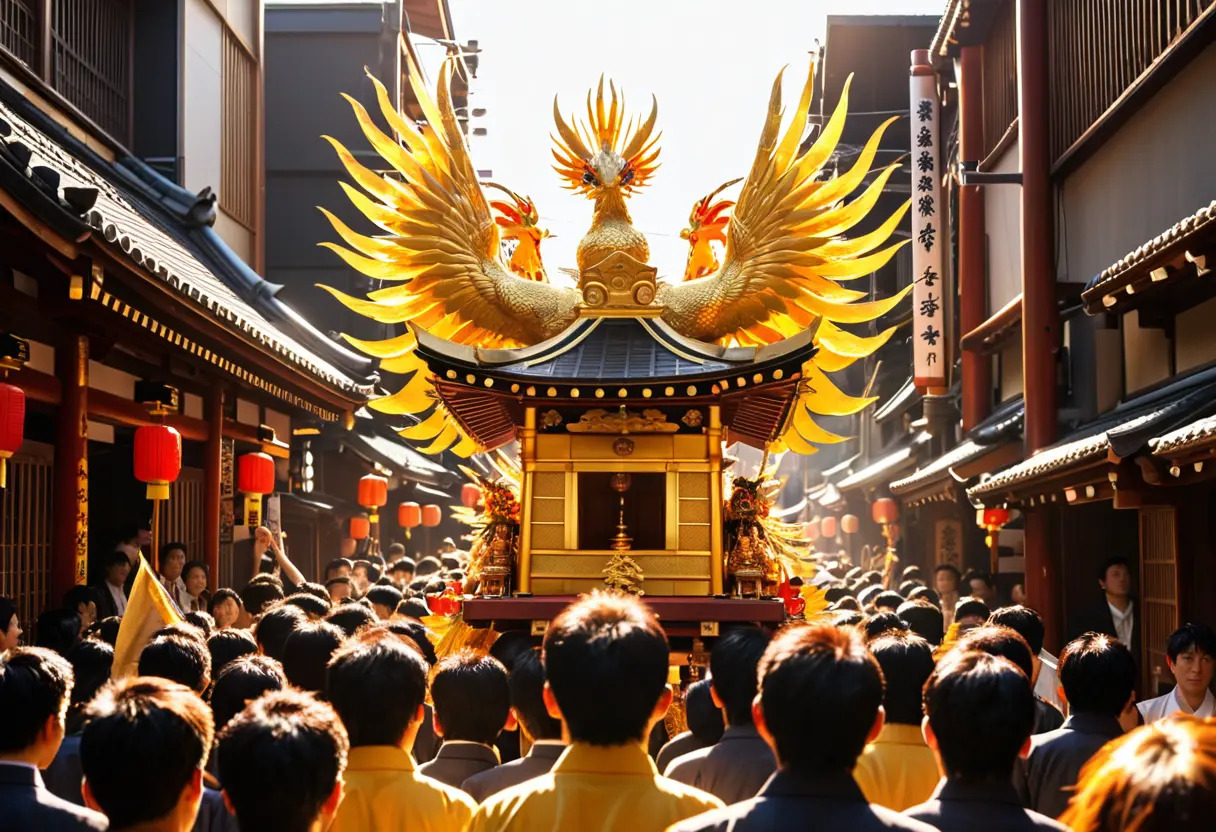
The Mikoshi and the Ark of the Covenant : The Sacred Ark (Aron HaKodesh), which held the Ten Commandments, shares its dimensions and basic structure with the Japanese Mikoshi (portable shrine). Both are covered in gold, carried on two poles by a chosen group, and featured winged figures (Cherubim in the Bible, a Phoenix on the Mikoshi) protecting the lid.
Yamabushi and Tefillin : Mountain ascetics known as Yamabushiwear a small black box called aTokin on their foreheads during prayer. This bears an identical resemblance—in shape, function, and placement—to the Tefillin worn by observant Jews during their morning prayers.
2. The Hata Clan: The Engineers of the Capital
The physical bridge for these traditions is often attributed to the Hata Clan (Hata-uji).
Surfacing around the 3rd to 5th centuries, the Hata were a powerful immigrant clan that brought advanced engineering, sericulture, and financial knowledge to Japan. They were instrumental in the construction of Kyoto (Heian-kyo) and the founding of major shrines like Fushimi Inari . Many scholars suggest the Hata were Nestorian Christians (Keikyo) or Jewish exiles who had adapted to the Silk Road before arriving in Japan, effectively seeding the Japanese state with Judeo-Western logic.
3. Linguistic Puns or Lost Memories?
Linguists have noted hundreds of “coincidences” between Japanese and Hebrew. While some dismiss these as “false friends,” the frequency is notable:
“Hakeppoi” / “Wasshoi” : Some interpret the sumo cry Hakeppoias Hebrew for “Throw it down,” andWasshoi as “God is coming.”
“Mikado” : The Japanese term for the Emperor (Mikado) echoes the Hebrew Migadol (The Great One).
“Sumo” : Some find a connection to the Hebrew Shemo(His Name).
Reflection: A Bridge across the Abyss
Whether theNichiyu Dousoron is a historical truth or a romanticized “pseudo-history,” its persistence speaks to a deep human desire for connection . It reframes Japanese history not as an isolated island narrative, but as the final destination of a global spiritual pilgrimage.
By looking for the “Israel in Japan,” we are searching for the universal threads that bind all civilizations together—the belief that even at the edge of the world, we carry the sacred memories of where we began.
The Takenouchi Documents: The Forbidden History : A banned text claiming Japan was the center of the ancient world.
The Keys of Solomon: Japan’s Hidden Treasure : The mystery of Mount Tsurugi and the Ark.
Iino UFO Town: The Alien Connection : When our origins are sought not in our past, but in the stars.
Beliefs Hub: The Power of Myth : Understanding how shared beliefs shape reality.