Teke Teke: The High-Speed Predator of the Cold Railway

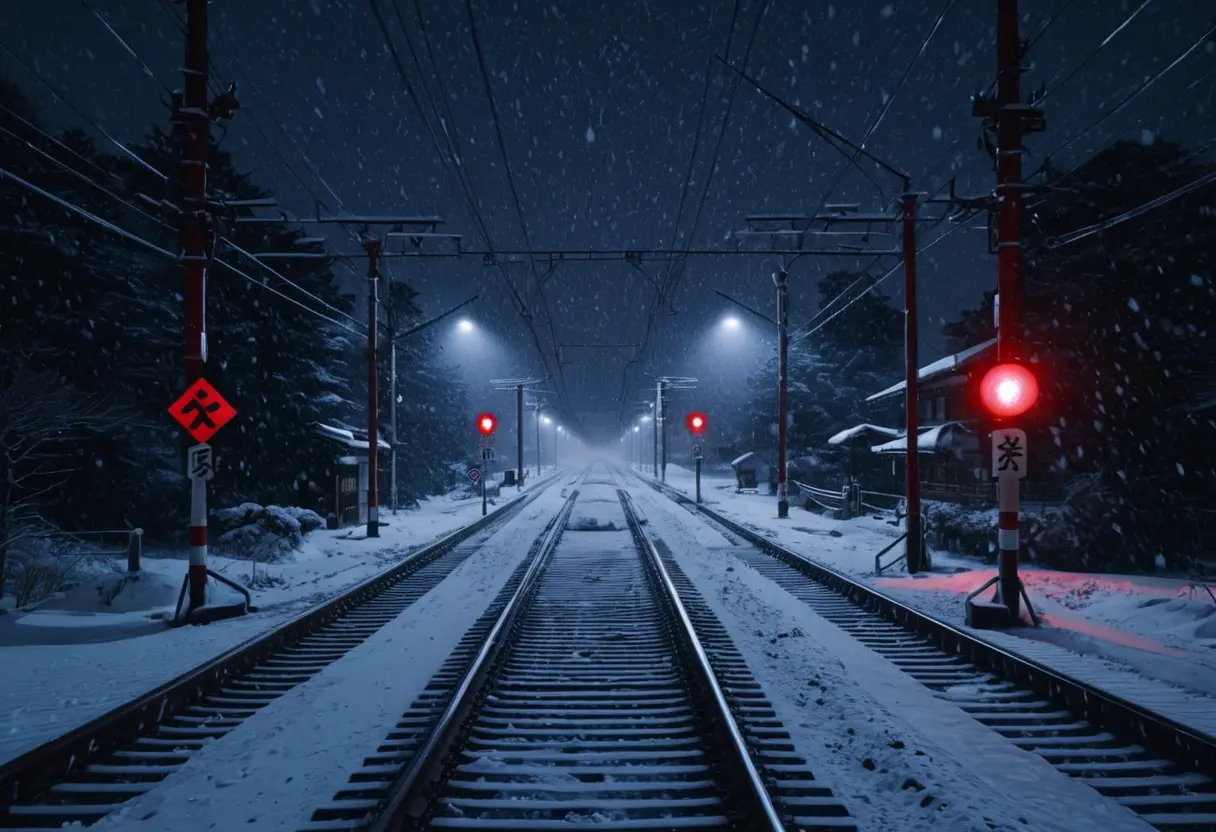
Hokkaido in winter. A deserted railway crossing in the bone-chilling cold.
If you hear a dry, rhythmic sound behind you—the sound of elbows or a severed spine striking the hard asphalt—do not look back. “Teke, teke, teke, teke…” When you hear that sound, the countdown to your end has already begun. Behind you is a figure who has lost her entire lower half, crawling at an impossible speed with a single, sharp goal: to make you like her.
While The Slit-Mouthed Woman allows for negotiation, the entity known as “Teke Teke” is a creature of pure, unavoidable Runtime Error . She is the ultimate symbol of the irrationality of death and the terrifying “Acceleration” of modern life—a process that severs the body from the logic of survival.
Frozen Veins: The Tragedy of the North
The origin of Teke Teke is rooted in a gruesome railway accident in post-war Hokkaido. At twilight on a snowy winter day, a young girl fell onto the tracks. A train, unable to stop in time, severed her body cleanly at the waist.
Under normal circumstances, such an injury would lead to immediate death. However, the extreme cold—reaching tens of degrees below zero—instantly froze and contracted her severed blood vessels. This cruel twist of nature stopped the lethal bleeding, keeping her conscious and alive in a state of impossible agony. Much like the biological horrors explored in Skin Respiration: The Suffocation Myth , Teke Teke represents the biological self pushed into a grotesque, supernatural state by environmental stress.
She survived for minutes, crawling with only her arms, pleading for help. But those who saw her were paralyzed by terror. Her despair and boiling hatred for humanity coalesced, transforming her into a Zuryo (a malicious spirit)—the Teke Teke.
150 km/h Despair: The Escapeless Predator
What sets Teke Teke apart is her extraordinary mobility . She has compensated for her physical loss with supernatural arm strength and a demonic obsession with speed.
Unmatched Speed : Originally said to move at 100 km/h, modern accounts claim she has accelerated to 150 km/h, rivaling the “Speedster” phantoms of modern highways.
Relentless Pursuit : She will crawl alongside your car window at night, matching your speed, laughing as she overtakes you.
Mechanical Sound : The name “Teke Teke” comes from the percussive sound of her elbows hitting the ground—a dry music of death.
This image of mechanical, sudden “severing” is the core of her terror. It is a Critical System Failure where the body is split between the “Analogue Past” (the railway) and the “Digital Future” (the high-speed pursuit). It is the fear that something from our forgotten history will suddenly overtake our high-speed civilization and force a hard reset.

Survival Protocols: Warding off the Hunter
Teke Teke is a physical entity of malice, making traditional prayers often ineffective. However, several “countermeasures” have been passed down:
Verticality (Stairs) : Traditionally thought to be her weakness, as she moves entirely with her arms.
Cornering Vulnerability : Her extreme speed makes her formidable on straightaways but vulnerable during sudden, tight turns.
The Question of Knowledge : Unlike the ritualistic Kashima Reiko , who can be satisfied with answers, Teke Teke offers no dialogue. She is the embodiment of a physical collision.
Reflection: A Metaphor for Accelerated Anxiety
The legend of Teke Teke can be seen as a manifestation of the “acceleration” of modern society. We live with the constant, irrational fear that something—an accident, a layoff, a sudden tragedy—will overtake our lives at a speed far beyond our control.
A white shadow running alongside your life at impossible speeds…
If you feel cornered today, listen closely to the sounds behind you. Is it just the wind, or the cold, rhythmic strike of elbows on the asphalt?
Kuchisake-onna: The First Analog Pandemic : The viral queen of high-speed urban legends.
Skin Respiration: The Biological Mystery : When the human body is pushed to its limits by myth and nature.
Kashima Reiko: The Questioning Shadow : The sister-spirit who hunts through the infection of words.