The Aokigahara Compass: The Unforgiving Sea of Trees and the Trap of the Earth

In the lexicon of Japanese urban legends, one phrase stands out:
“If you step into the Sea of Trees (Aokigahara), your compass will spin wildly, you will lose your way, and you will never return alive.”
Aokigahara is a vast primeval forest spreading across the foothills of Mount Fuji. Built upon the lava flows from an eruption 1,200 years ago, this forest hides countless tales of death and mystery beneath its beautiful, mossy surface. The legend of the “spinning compass” has become the definitive icon defining this forest as an “otherworld” where science fails.
But does a compass really “go mad” there?
The truth lies in a combination of geological memory and the fragile psychology of the human brain.

1. The Geological Truth: Magnetic Ore of the Ancient Lava
The story of “magnetic interference” is not entirely a lie.
Around 1,200 years ago, the Jogan Eruption (864 AD) sent a massive flow of basaltic lava from Mt. Fuji, which formed the foundation of today’s forest. This lava is extremely rich in magnetite , a mineral with natural magnetic properties.
Localized Deviation : If you place a compass directly onto a patch of rock rich in magnetite, the needle will indeed be pulled by the rock’s magnetism, and may deviate by several degrees or more.
Normal Measurement : However, if held at a normal height (around waist level), the massive “geomagnetism” of the Earth itself is far stronger, and a compass will point toward the North correctly.
The fact that the Self-Defense Forces and local search-and-rescue teams navigate the forest using standard compasses is the strongest evidence that they function normally. Why, then, did the image of the “mad compass” become so entrenched?
2. The True Threat: “Ring Wandering” - The Circle of Death
The real reason people get lost in Aokigahara is not a compass failure, but the fragility of the human sense of direction .
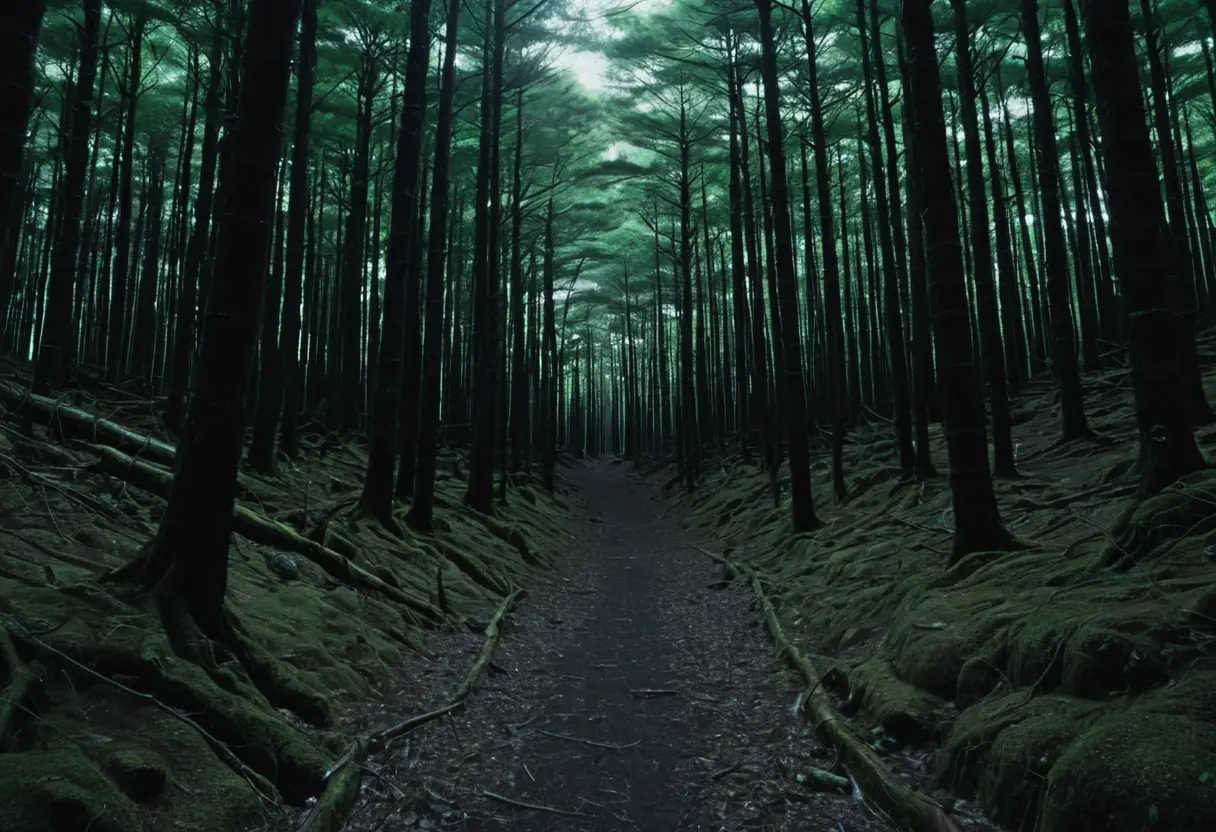
Inside the forest, every view is a repetition of the same landscape: moss-covered lava, tangled roots, and a thick canopy that blocks out the sky. There are no high mountains or buildings to serve as landmarks.
In this environment, a phenomenon called “Ring Wandering” (or circular wandering) occurs.
When humans walk through a dense forest or plain without visual landmarks, subtle differences in leg strength or stride length accumulate. Even if you think you are walking perfectly straight, you unconsciously trace a giant circle, returning to your starting point after several hundred meters.
“No matter how much I walk, I return to the same spot. The compass must be broken!”
This misunderstanding, born of extreme stress, reinforced the urban legend. Once panic sets in, a person exhausts their energy and is eventually swallowed by the forest in hunger and cold.
3. The Modern Barrier: Trees that Reject Digital Signals
Some believe that modern smartphone GPS makes the forest safe, but the “Sea of Trees” has physical ways to neutralize even our most advanced tools.
Signal Obstruction : In deeper parts of the forest, the combination of iron-rich lava and several layers of dense foliage can obstruct the weak signals from GPS satellites, significantly reducing accuracy.
Rapid Battery Drain : Because the device constantly struggles to find a signal from cell towers, the battery drains at an accelerated pace. The moment the digital map vanishes, a modern traveler is rendered more helpless than a castaway from the Edo period.
Reflection: Urban Legend as a Warning
The story of the “spinning compass” may be, in a sense, a “spiritual barrier” born from a healthy fear of nature. It is a desperate warning from our ancestors: “This is a place where human logic and tools do not apply. Do not approach out of curiosity.”
Viewed from the safety of the official walking paths, Aokigahara is a beautiful primeval forest teeming with a rare vitality found nowhere else in the world. But the moment you step outside that “order,” it becomes a cruel sanctuary where your spirit—not your compass or your phone—is tested.
If you ever feel the compass is wrong, it might not be the needle that has gone mad, but your own heart for daring to enter. Somewhere deep in the woods, the mossy rocks are waiting for you to realize this—perhaps when it is already too late.
Tatsuki Ryo’s 2025 Prophecy: The Future I Saw : Another great disaster predicted to strike Japan.
Inunaki Village: The Village Erased from the Map : Another forbidden zone in Japanese lore.
Pole Shift: The Magnetic Reset : The day when compasses truly become useless on a global scale.