The Golden State Killer: The Total Victory of 'Forensic Genealogy' That Broke a 40-Year Silence
He was none other than the “Golden State Killer,” the worst serial killer who plunged the entire United States into the depths of terror from the 1970s through the 1980s.
His arrest was not merely the resolution of a cold case. It was a paradigm shift moment that forever rewrote the history of criminal investigation itself, announcing the “End of the Perfect Crime.”

1. The Despair Brought by the “East Area Rapist”
DeAngelo’s crimes were filled with abnormal persistence and calculation. Feared by different names each time his crime area changed—such as the “East Area Rapist (EAR)” and the “Original Night Stalker (ONS)"—he committed at least 13 known murders, assaulted over 50 women, and carried out more than 120 burglaries.
His methods were pure cruelty. He would surveil a target’s home for days in advance, understanding the layout of open windows and door locks. He invaded late at night, blinded the victims with the intense glare of a flashlight, and bound them. In many cases, he bound the husband, threatened the wife declaring, “If he moves even a little, I’ll kill him,” and repeatedly committed the extremely despicable act of assaulting the wife right in front of the husband. He often left traces of having eaten a meal in the kitchen at the crime scene—a typical psychopath utterly violating the “safe sanctuary” of a home.
2. A Cold Case and the Trap of “Forensic Genealogy”
DNA analysis technology at the time was immature, and DeAngelo knew police methods thoroughly (as he himself was a former police officer). Without leaving decisive evidence, he suddenly vanished, and the cases went completely cold for nearly 40 years.
However, the situation changed entirely in the 2010s. The investigative authorities utilized a completely new approach as a desperate measure: “Forensic Genealogy.” Investigators uploaded the criminal’s DNA data, a tiny amount of which remained at the scenes, to an open-source DNA ancestry search site (GEDmatch) —used by the general public to trace their ancestors—under a fake name. Naturally, the criminal himself would not have registered his DNA. However, several of his “distant relatives (third to fourth cousins, etc.)” matched. 
3. Reverse-Engineered Family Tree and the Final Judgment
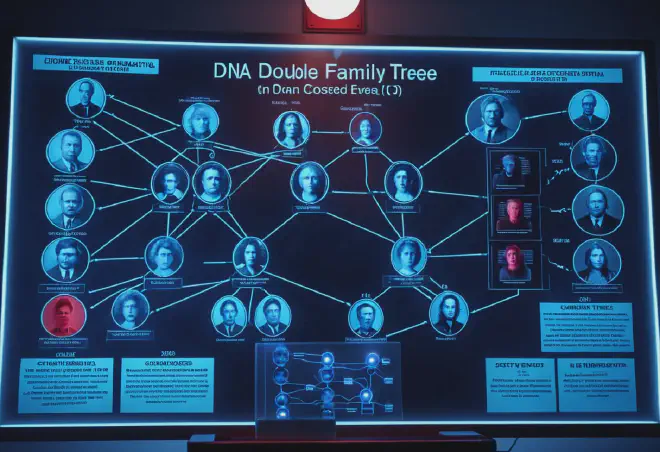
From here on, it was an investigation of sheer tenacity. Starting from the several distant relatives who matched, they traced the family tree back to the 1800s, and from there constructed a massive family tree downward. From countless branches and leaves, they overlaid profiling data such as age at the time of the crimes, residential history, and “criminal records,” narrowing down the targets through a process of elimination.
And the single branch left at the end—that was DeAngelo.
Police recovered a tissue from a trash can he had discarded and verified the DNA. The result was a perfect match.
The man who appeared in court in a wheelchair was a frail old man, lacking any shadow of the “demon” that once made all of California tremble. Yet, the scars he left will never disappear. His arrest became a death sentence to perpetrators of unsolved crimes worldwide who had been relieved, thinking they had escaped the past.
Today, many cases are finding the thread to a resolution one after another via this “Family Tree DNA Investigation.” In the modern era where big data and genetic science intersect, even blood ties have become “evidence” from which one can no longer run or hide.