Annabelle: The Pure Malice within the Glass Case

Annabelle stands as a testament to the power of “silent malice” in contemporary horror. She does not wield a weapon or chase her victims; she is a “Supernatural Portal” —a benign-looking object that anchors a demonic presence to our physical reality.
First introduced in The Conjuring, her popularity led to a dedicated film series that explores the tragic origin of the vessel and the chaos she brings to those who dare to possess her.
1. Disguised Innocence: The Toy as a Filter
The horror of Annabelle is rooted in the subversion of childhood safety. *The Uncanny Resident : The film version of Annabelle, with her cracked porcelain face and a frozen, sinister smirk, is designed to trigger our biological “Uncanny Valley” response. The contrast between an object meant for comfort and a vessel for spiritual rot creates a state of constant psychological friction. *The Power of Stasis : Her terror is expressed through “Absent Movement.” You never see her walk, yet when you blink, she is in a different room, or her head has turned to track your position. She commands the space around her simply by existing.
2. The Objective: Hunting the Soul
Unlike a common ghost seeking closure, the entity within Annabelle is “Inhuman”—a demonic force with a specific, predatory goal. *The Path of Oppression : The spirit does not attack immediately. It begins with local anomalies—moving objects, strange sounds—designed to weaken the mental state of its victims. A soul broken by despair and paranoia is far easier for a demon to “possess.” *The Real-World Legend : In reality, the doll kept by the Warrens is not a porcelain figure but a mass-produced Raggedy Ann doll (made of fabric). The Warrens argue that the “ordinary” look of the real doll makes it even more dangerous, as it is more likely to be welcomed into a home without suspicion.
3. The Sealed Evil: The Boundary of the Glass
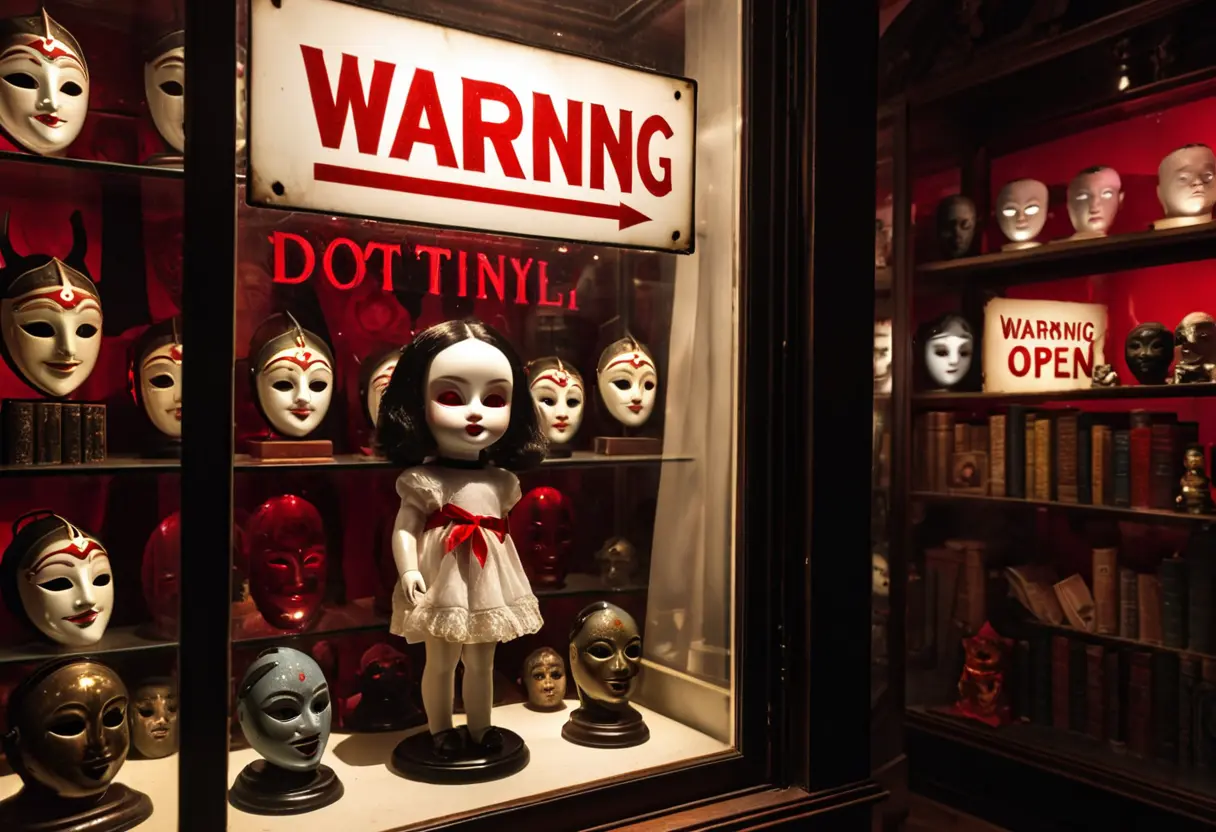
Today, Annabelle remains locked within a special wooden and glass case in the Warrens’ Occult Museum. Once a week, a priest visits to perform a cleansing ritual and bless the container.
The warning sign on the case—“POSITIVELY DO NOT OPEN”—is more than a museum label; it is the only barrier between a peaceful daily life and an ancient, pulsating malice. When we watch Annabelle on screen, we are reminded that some doors, once opened, can never truly be closed.
*The Warrens’ Occult Museum : A catalog of the most dangerous artifacts in the collection. *Robert the Doll: The Living Toy : Investigating another infamous real-world haunted doll. *The Conjuring: The Birth of a Shared Universe : How the Warrens’ case files became a cinematic phenomenon.