The essence of occult horror lies in its ability to expose how our “Civilization” and “Reason” are mere thin layers or parchment stretched over the mouth of hell.
No matter how much medical science or logic advances, there remain “Stagnant Zones” where these tools fall silent. From those shadows, an ancient, prehistoric agency reaches out to touch our world, demanding a recognition that transcends the rational mind.
The Invasion of the Spiritual Sanctuary
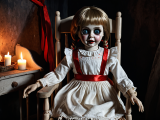
Many occult films depict the slow, methodical erosion of what should be most protected—the innocence of a child or the peace of a family unit—by demonic forces. *Possession : The horror of one’s own body becoming a host for an “Evil Other.” To be consumed from within by an entity that is not yourself is the ultimate form of despair—the negation of the individual soul. *The Weight of Artifacts : A doll, a music box, or a dusty manuscript. These seemingly inanimate objects serve as “Portals”—physical anchors for an ancient malice that survives across generations, waiting for a human hand to touch it.
The Collision of Faith and Skepticism
The battlefield of the occult is always set on the boundary of “Belief.”
The modern mind, which mocks and denies the supernatural, is forced to kneel before events that are physically impossible. In these moments, cinema transcends entertainment to become a theological and philosophical inquiry. Each time we hear the mockingly low voice of a demon through a screen, we are reminded of the abyss that lies beneath the very ground we stand on.
Featured Archives
The gold standard. Analyzing the clinical, documentarian approach to a young girl’s possession and the crisis of faith that followed.
Based on the true files of the Warrens. A masterclass in traditional atmosphere and the bond of a family against a multi-generational curse.
Exploring the realm of “The Further.” What happens when your soul travels too far, and your physical body is left as an open door for the dead.
The Catalog of the Profane *Annabelle: The Demon in the Doll : Investigating the most dangerous object in the Warrens’ Occult Museum. *The Anatomy of Exorcism : From ancient rites to modern psychological interpretations. *Historical Hauntings: True Occult Cases : Where movie fiction meets the reality of the paranormal world.