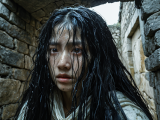
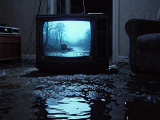
The J-Horror movement, which swept the globe from the late 1990s through the early 2000s, presented a paradigm of terror fundamentally different from the “Jump Scares” and “Physical Destruction” of Hollywood.
It is a cinema of the infinitesimal—an art form that amplifies the minor anomalies of the everyday: the slight gap in a sliding door, the ripple of a curtain, the static noise on a screen. To watch a J-Horror masterpiece is to witness the transformation of your own safe home into an “Otherworld” where logic no longer applies.
The Aesthetic of Humidity: The Particles of Malice
J-Horror possesses a unique, tactile “dampness.” It is the smell of rain, stagnant water, or the moldy rot of an ancient building. *The Inexorable Cycle (The Curse) : There is no reasoning with a J-Horror entity and no simple purification ritual. Malice in this world is an absolute, systematic program of destruction. Icons like Sadako and Kayako are not mere ghosts; they are viral pathogens of suffering. *The Terror of the Margins : J-Horror rarely places the monster in the center of the frame. Instead, they are placed in the background, or in the corner, blending into the clutter of the room. This forces the viewer into a state of doubt—“Did I just see that?"—followed by a cold, quiet confirmation that is more terrifying than any scream.
The Decay of the Social Fabric
Beneath the supernatural veneers of these films lie the heavy themes of modern Japanese society: profound solitude, domestic abuse, and the collapse of the family unit.
Lonely deaths, fractured relationships, and the “forgotten people” who fall through the cracks of the city. Their screams turn into vengeful spirits that knock on our doors. They do not seek salvation; they only seek to share the same despair they experienced until the whole world is part of their ring.
Featured Archives
The origin point. Exploring how information technology turned an ancient well-spirit into a global epidemic of death.
A study in localized hatred. When a single home becomes a magnetic field for tragedy, consuming all who step inside.
The most emotional work of the genre. How the bond of motherhood is tested against the rising tide of eternal loneliness.
The Catalogue of Shadows *One Missed Call : The melody of death that travels through the airwaves. *Noroi: The Curse : A terrifying mockumentary exploration of ancient folk-taboos. *Sadako Yamamura : A deep dive into the psychic girl who became the queen of J-Horror. *Kayako Saeki : The tragic, crawling mother who embodies relentless obsession.