Mongolian Death Worm: The Acid-Spitting Intestine of the Gobi
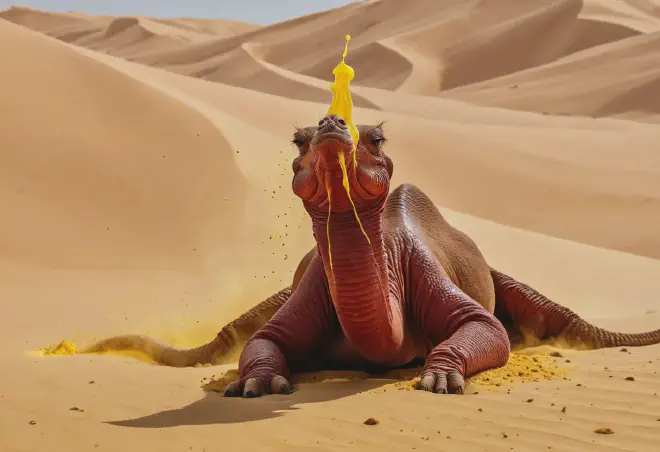
The Mongolian Death Worm . A thick, blood-red tube of flesh that supposedly kills from a distance using lethal electricity and corrosive acid. Is it a misidentified snake, or a biological anomaly perfected for the most extreme environment on Earth?
1. Living Weaponry: Lethal Specs
The terror of the Death Worm comes from its reported ability to kill without physical contact. *Electric Discharge : The most baffling claim is that the worm can emit high-voltage shocks from its body, capable of killing a human or a camel instantly from several feet away. *Corrosive Acid : It is said to spray a yellow, highly toxic acid that corrodes anything it touches—even metal—on contact. *Alien Morphology : Witnesses describe a creature roughly 2 to 5 feet long, looking like a wet, pulsating intestine. It has no distinct head, tail, or eyes, appearing as a featureless cylinder of death emerging from the sand.

2. Records: From Roy Chapman Andrews to Modern Scans
The Western world was first introduced to the creature in 1926 by the American explorer Roy Chapman Andrews (a primary inspiration for Indiana Jones). *The Nomad’s Taboo : Andrews was stunned to find that high-ranking Mongolian officials and nomads alike believed in the creature with absolute certainty and profound fear. *The Invisible Predator : Since 1990, numerous scientific expeditions from the UK and Czech Republic have scoured the Gobi using thermal imaging and seismic sensors. No physical specimen or fossil has ever been recovered, suggesting the worm is either incredibly rare or highly sensitive to the vibrations of human searchers.
3. Scientific Theories: Adaptations of the Sand
If the Death Worm exists, where does it fit in the tree of life? *Tartar Sand Boa : A red snake that lives under the sand. While it looks similar, it possesses neither poison nor electricity. *Amphisbaena (Worm Lizards) : A legless reptile specialized for underground life. *Electro-Static Lifeform : One fringe hypothesis suggests the worm has evolved a unique organ that accumulates static electricity from the friction of moving through dry desert sand, allowing it to discharge it as a defense mechanism.
4. The Red Abyss
The Mongolian Death Worm is the desert’s way of manifesting its own unforgiving nature.
If you travel through the Gobi and notice a rhythmic heaving of the sand and feel the hair on your arms stand up from a sudden static charge… do not stop to investigate. You may be about to witness the last thing many nomads have seen: the opening of the red abyss.