Elements: The Four Breaths and Two Abysses of the World
In a fantasy world, every substance, magic, and life-form obeys specific Elements .
Fire melts ice, and lightning travels through water. These interactions are not mere game calculations; they are the most basic proofs of “Magical Physics,” showing the very “Logic (Kotowari)” by which the world is woven.
1. Origins: Ancient Philosophy and the “Four Elements Theory”
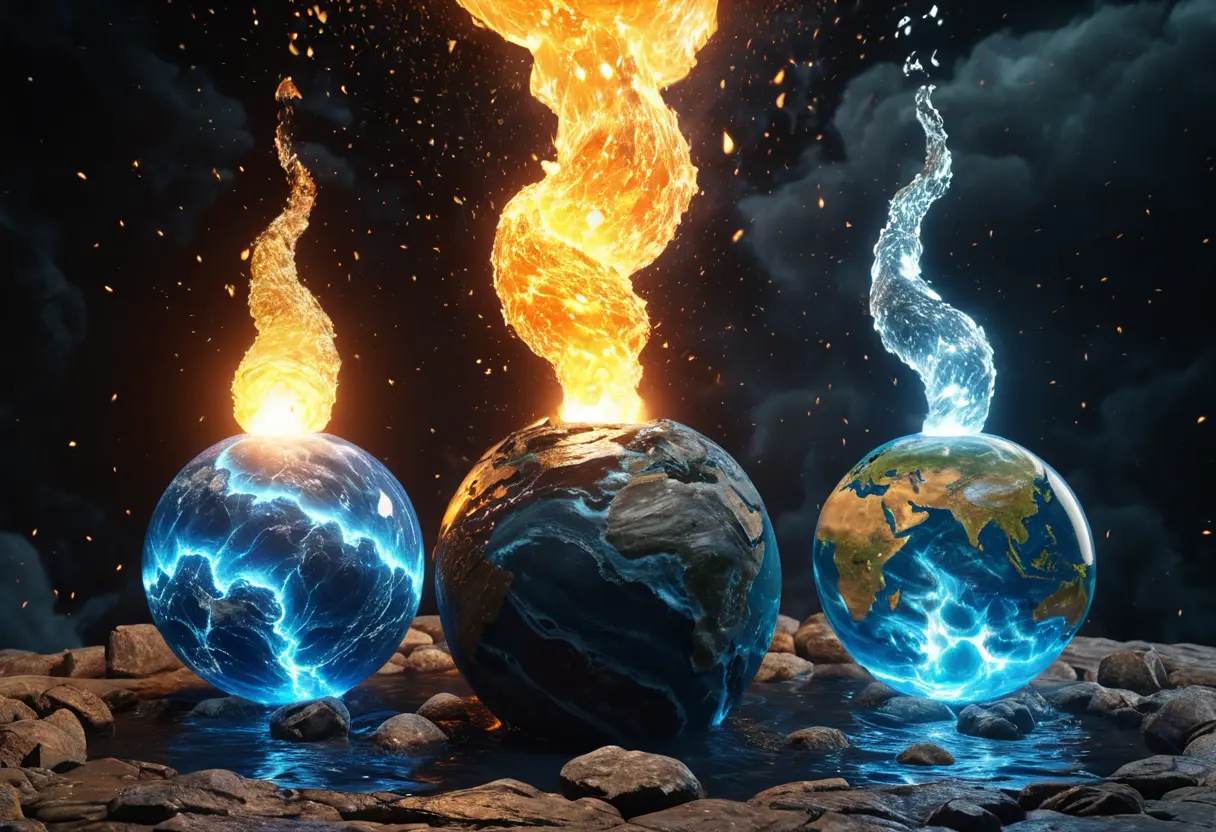
The framework of the concept of “elements” dates back to the earliest natural philosophies in human history. *Empedocles’ Proposition : The ancient Greek philosopher Empedocles taught that all things are composed of four “roots (rhizomata)”: Fire, Water, Earth, and Air. This is the direct root of the “Four Elements” in Western fantasy. *Asian Wuxing (Five Elements) : Conversely, in Eastern fantasy, the “Five Elements” (Wood, Fire, Earth, Metal, and Water) form the foundation. These were defined not just as substances, but as a dynamic cycle of creation (Generating) and suppression (Overcoming).
2. Structure: “Rock-Paper-Scissors” and Resonance as Strategy
In the RPG genre, elements have evolved the game into a “Combat of the Intellect.” The Drama of Affinity : The possibility that an absolute powerhouse can be brought to its knees by a single elemental weakness provides the player with strategic catharsis. From PokémontoFinal Fantasy*, elements are the core of advanced intellectual entertainment. *Elemental Personalities : Fire stands for “passion and destruction,” Water for “healing and flux,” Earth for “patience and constancy,” and Air for “freedom and intellect.” Elements are not just attack types; they implicitly define the Personality of those who wield them.
3. High-Order Elements: Light and Dark, Law and Chaos
Beyond the physical four elements lie the “High-Order Elements” that support the ethical and spiritual backbone of the world. *Light and Darkness : More than mere illumination, these symbolize “Holy Salvation” versus “Primal Terror” or “Hidden Truths.” *Law and Chaos : Emphasized in D&D, this conflict sublimates elements from “properties of matter” to the “orientation of the soul.”
4. Cultural Context: An “Elemental Way of Seeing” the World
The elemental system is a “tagging” process that makes complex phenomena easier to understand.
While science deconstructs the world into atoms and molecules, fantasy integrates the world through “Meaning” via elements. We are enthralled by fire magic and drawn to the silence of ice because this intuitive symbolism resonates with the primal awe of nature etched into our DNA.
*Magic Schools : Theories on how each school draws out and processes elemental power. *Mana : The transparent “raw magic fluid” before it is colored by an element. *Ability Scores : Resistance and mastery over elements often depend on physical “Constitution (CON)” or mental “Wisdom (WIS).” *Elementals : Entities that are the elements themselves given consciousness. *Ragnarök : The apocalyptic breakdown of elemental balance where all returns to nothingness.