Worldbuilding from Language: The Zenith of Internal Consistency in Middle-earth
In modern fantasy, the word Worldbuilding has gained special weight entirely due to the work of J.R.R. Tolkien.
He called his creative activity “Sub-creation.” It was a noble intellectual act: not imitating the primary world given by God, but using human imagination to build a “Second Reality” with its own internal consistency (logic).
1. Language First, Story After: Linguistic Foundation
Tolkien’s process was the reverse of typical authors. As a philologist, he first created a “Language” and then needed a “Place” and “History” for that language to be spoken. *A Civilization of Vowels and Consonants : The Elvish languages like Quenya and Sindarin are perfectly designed, down to grammar, vocabulary, and scripts (Tengwar). The “Sound” of the words directly determines the personality and culture of the race. *The Weight of Naming : Every place-name and personal name in Middle-earth has an etymological meaning. This “Persuasiveness of Naming” gives readers the illusion—that is, immersion—that “this world was not made up by someone, but has been named over long years.”
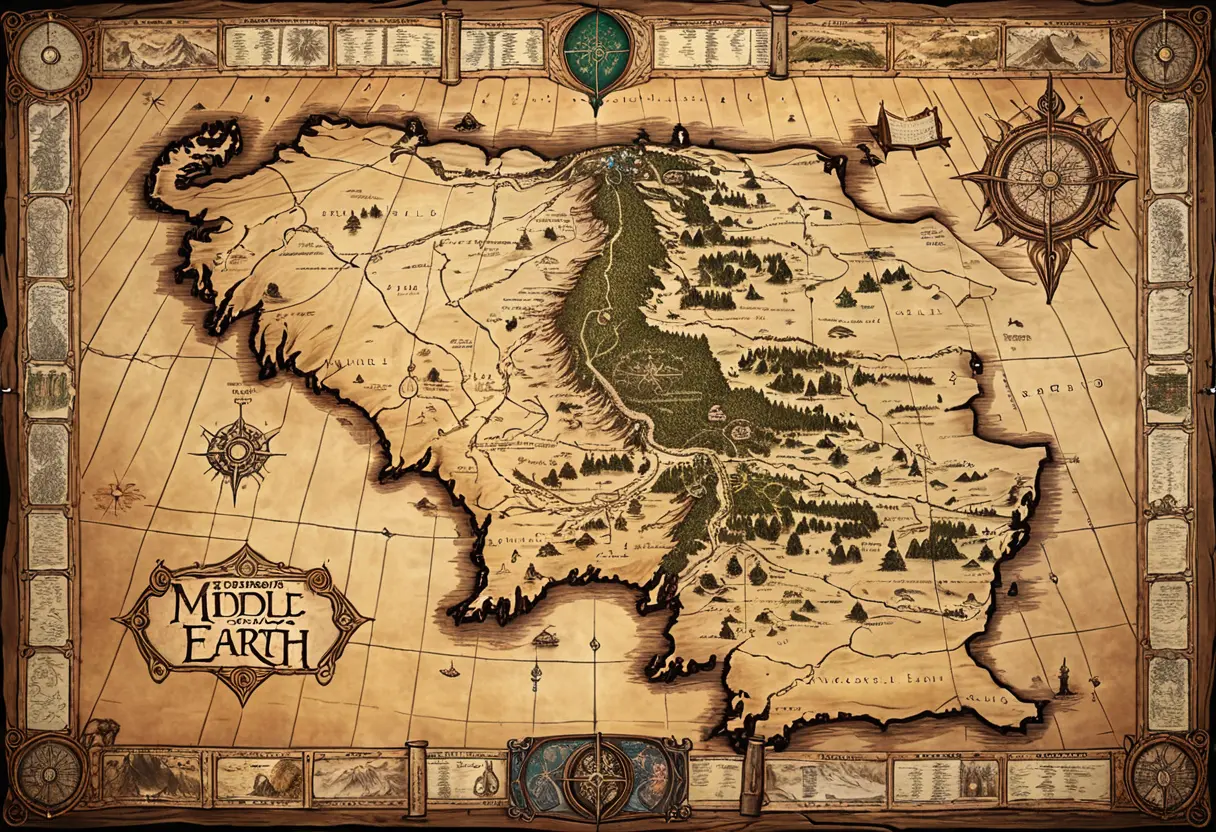
2. Maps and Timelines: “Three-Dimensional Depth” of Space and Time
The maps Tolkien drew were not mere illustrations; they were precise blueprints governing the “Breath” of the story. *Three-Dimensional Necessity : The location of mountain ranges, the direction of rivers, and the distances travelers can walk in a day. All these geographical consistencies give the story “Physical Weight.” *Layers of History : Reading Tolkien, one encounters “ruins of great kings” or “records of ancient wars” everywhere. Thousands of years of history (detailed in The Silmarillion) unrelated to the immediate plot pile up like “strata” behind the current narrative. This “vastsness of the background” is the source of Tolkien’s realism.
3. Internal Consistency: The Unbroken “Secondary Reality”
The most important aspect of worldbuilding is that the “Rules” within that world never collapse. *The Etiquette of Making Lies Truth : In Middle-earth, magic and miracles happen according to the laws of that world. The moon waxes and wanes as calculated; the constellations have meaning. The author’s stoic refusal to bend the rules for convenience wins the reader’s “Suspension of Disbelief.”

4. Cultural Context: Settings as a “Secondary Play”
The enjoyment of poring over “Setting Manuals” in modern games, especially RPGs and Open Worlds, exists because Tolkien proved that settings themselves can be a great art form.
We wish to know when and by whom the Ring was forged as much as we wish to see Frodo discard it. Worldbuilding is a device that transforms the reader from a mere “spectator” into a “Historian” or “Explorer” of that world.
▲ Back to Fantasy Dictionary Top