The Dawn of CRPG: Establishing the 'Other Labyrinth' inside the Screen
In the mid-1970s, at the terminals of giant computers (mainframes) in American universities, young students began an experiment. It was a trial to have the computing power of a machine—rather than a human—automatically execute the complex tabletop game Dungeons & Dragons (D&D) that was popular at the time.
This was the birth of the Computer RPG (CRPG) we know today.
1. Primordial Code: The PLATO System and the Birth of the “Labyrinth”
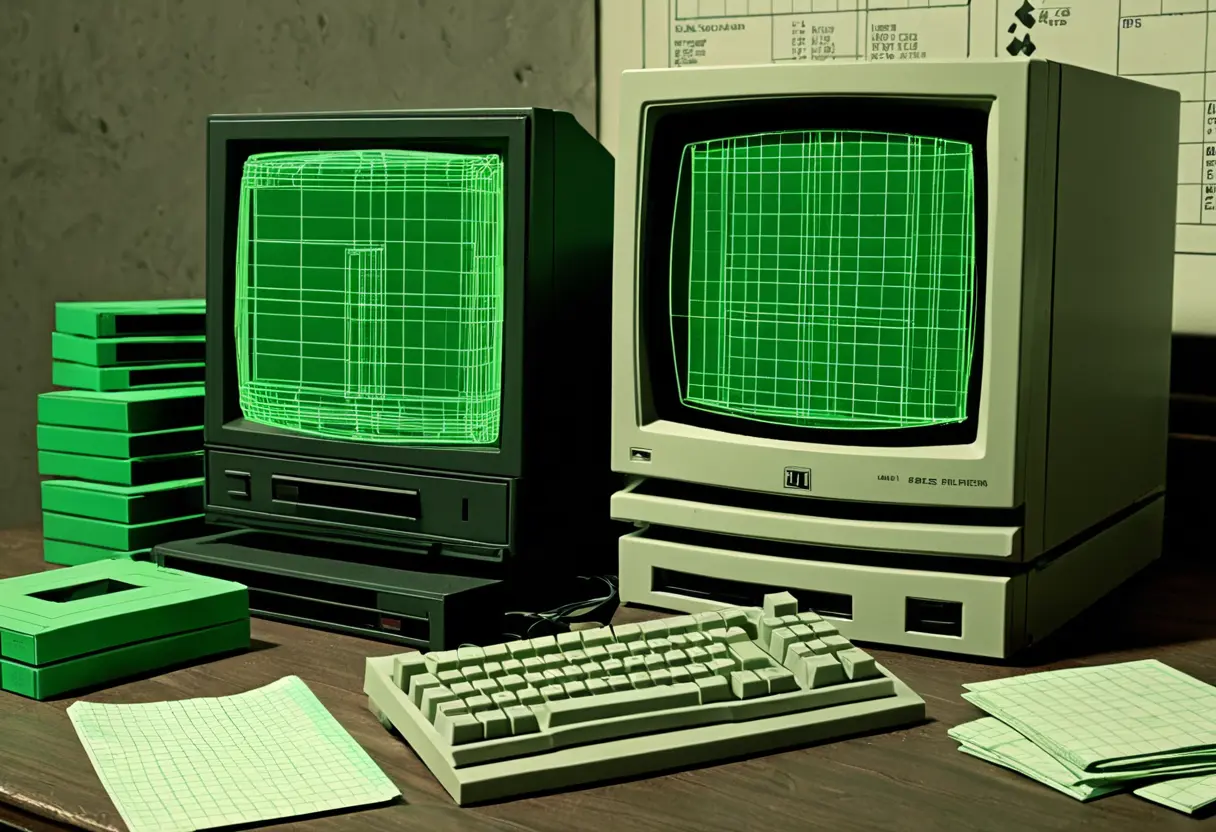
The true roots of CRPG lie in early programs like pedit5anddnd born on the “PLATO” educational network system. The Automated Dungeon Master : Rolling dice, managing monster HP, and calculating experience points. By having the “Program” take over these tedious tasks, players could immerse themselves in the adventure world alone, at any time. Shock of the Wireframe : Early works like AkalabethandWizardry appearing in the early 1980s reconstructed what had been text-only worlds into spatial ones with “Three-Dimensional Depth” using wireframes (line drawings).
2. Establishing the Two Giants: Wizardry and Ultima
In 1981, two works that would determine the history of CRPGs were released for the Apple II. *Wizardry — “Vertical Exploration” : Diving into an eerie labyrinth, defeating monsters to collect “Rare Items,” and strengthening characters to the limit. This hardcore game design was later inherited by Japan’s Dragon Quest, becoming the aesthetic of JRPGs. *Ultima — “Horizontal Adventure” : Traveling across a vast field, talking with NPCs, and questioning the virtues needed to save the world. This style of “Living within a Story” became the ancestor of Final Fantasy and modern Open World RPGs.
3. Dissemination to Japan: The “Unique Evolution” of JRPGs
When these games born in America crossed to Japan, a unique chemical reaction occurred. *Refinement of Story and Character : Merging the stoic calculator-style CRPGs with the sensibilities of manga and anime. By adding characters easy to empathize with and dramatic stories, Dragon Quest became a national hit, establishing the unique genre of “JRPG” worldwide. *Systems Completing the Imagination : Adventures where one once had to draw maps on graph paper have now evolved to auto-mapping with a single button. Yet, the underlying joy of growth—that “increasing numbers make you stronger”—since D&D remains unchanged and continues to stimulate our brains.

4. Cultural Context: Why We Entrust Dreams to “Numbers”
Why do we feel such a sense of achievement when a “Level” on a screen goes up?
Perhaps it’s because real society is sometimes opaque, full of absurdities where effort and results don’t connect. The world presented by CRPGs is a kind of Utopia: no matter how harsh, “there are rules, efforts are visualized as numbers, and they will always be rewarded someday.” Beyond the labyrinth drawn in dots, a “Certain Response” that we find hard to get in reality awaits us.
▲ Back to Fantasy Dictionary Top