Bahamut: From the World-Supporting Fish to the King of Dragons
For modern gamers, especially those familiar with the Final Fantasy (FF) series, the name Bahamut is synonymous with the “Ultimate Dragon.”
However, from the perspective of mythology, Bahamut is the entity that has undergone the most dramatic “transmutation” in fantasy history. How did a single fish swimming in the vast oceans transform over thousands of years into a King of Dragons ruling the skies? The answer lies in the transmission of culture and bold redefinitions through game design.
1. The Origins: The “Cosmic Fish” of Islamic Cosmology
The original Bahamut is a gargantuan fish (or whale) in Islamic cosmology said to “physically support the world.” *The Three-Layered Foundation : In the Arab worldview, at the bottom of the earth is a mountain of rubies, supported by a giant bull named Kujata , who in turn stands upon the back of a vast fish swimming in an infinite ocean: Bahamut . *Connection to Behemoth : The name is said to be a corruption of the “Behemoth” from the Old Testament. In other words, what was originally a “Land Beast” was transformed into a “Sea Fish” within Islamic traditions.

2. Transition to Dragon: The “Creative Misunderstanding” of D&D
The decisive moment Bahamut became a “Dragon” occurred in the 1970s with the release of the world’s first role-playing game, Dungeons & Dragons (D&D) . *The Dragon King as an Attribute : The creators of D&D collected resonant names from world mythologies. During this process, they defined Bahamut as the “Platinum Dragon King” of good alignment. It is said there was no explicit literary basis for this—it was merely an intuitive naming choice. *Conflict with Tiamat : Simultaneously, the name of the Mesopotamian goddess Tiamat was chosen for Bahamut’s nemesis (the Evil Dragon Queen). This established a strong, permanent bond between “Bahamut” and “Dragon” within the core of game systems that had no prior connection.
3. Deification in Japan: Establishing the King of Summons
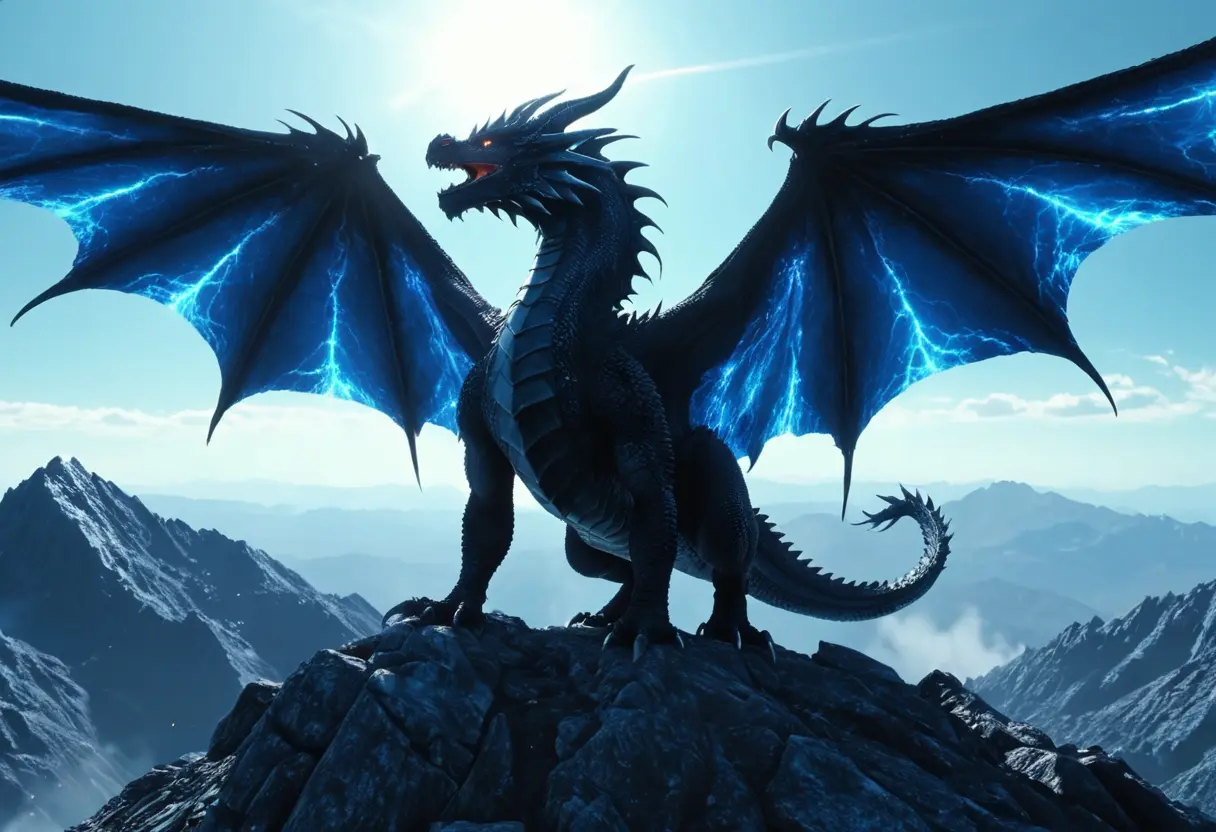
In the Japanese Final Fantasy series, which was heavily influenced by D&D, Bahamut underwent further evolution. *The Destruction God of Megaflare : Since FFIII, Bahamut became the iconic “King of Summons,” unleashing the non-elemental spell “Megaflare.” In Japan, the visual of “Bahamut = Black Dragon” became completely established, with those knowing his original form as a fish becoming a small minority. *A Pillar of the Narrative : Transitioning beyond a mere monster, Bahamut is now often depicted as a world-mediator or an “absolute power” that the player must overcome. The role of “supporting the world” that the fish once held has been inherited in modern times as a “spiritual pillar of the story.”
4. Cultural Context: Mythology Continues to “Evolve”
The case of Bahamut shows that mythology is not a fixed set of knowledge, but a “living entity” constantly updated by the human imagination.
From the perspective of traditionalists, a fish becoming a dragon may be a “mistake.” However, the fact that the “Dragon King Bahamut” born of that misunderstanding is etched into the memories of millions as a “new myth” is also significant. Fantasy is an endless adventure, where modern sensibilities bloom from the soil of ancient legends.
▲ Back to Fantasy Dictionary Top