The Druid: The Mediator of Nature and the Priest of the Primal Balance
In modern fantasy, the Druid is often portrayed as a benevolent sage who loves animals and protects the forest. However, the historical Druids of ancient Celtic society were far more complex—they were a feared Intellectual Elite with power exceeding that of kings.
To a Druid, nature is not just something to be “protected”; it is a manifestation of an indifferent, cosmic force that must be balanced, even at the cost of human life.
1. Roots: The Sages of the Oak and the Unwritten Code
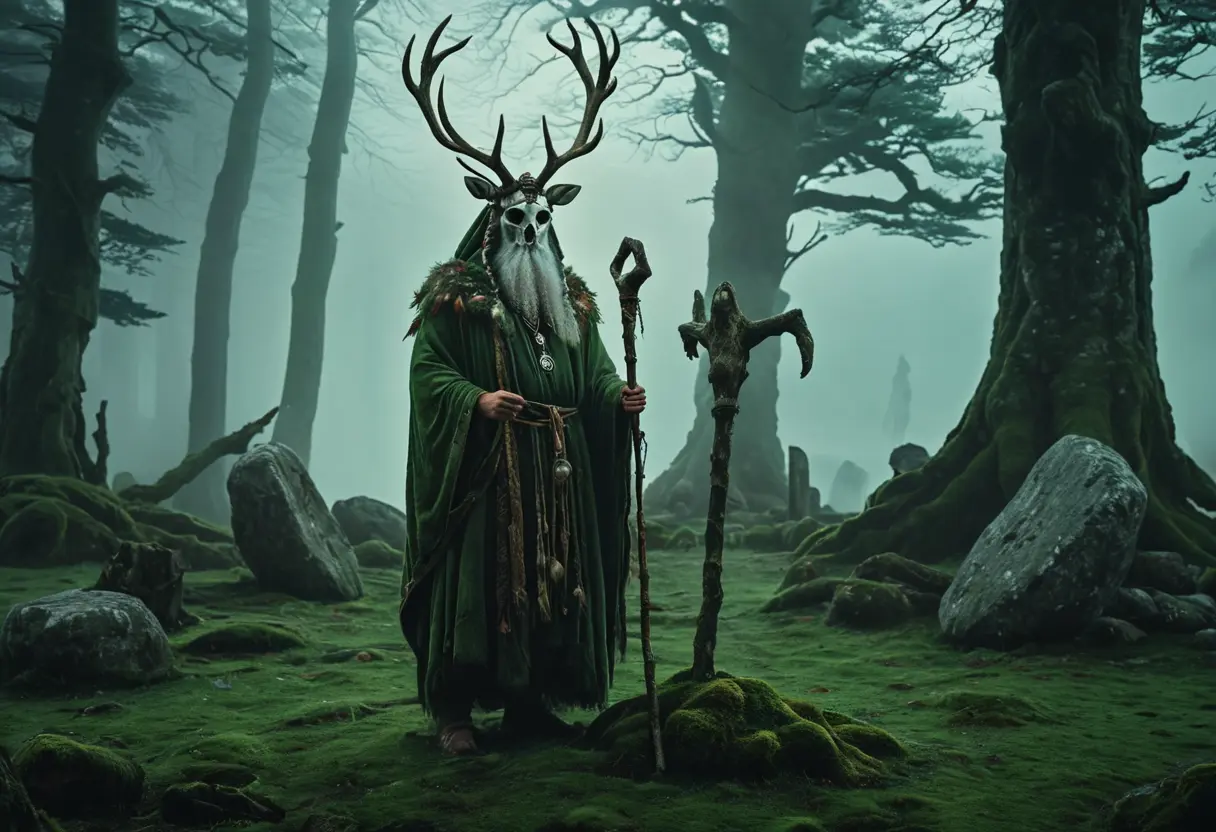
The name “Druid” originates from the Celtic words for “Oak” and “Knowledge” (Daru-Vid). *The Totalitarian Intellectuals : In pre-Christian Britain and Gaul, they served as priests, judges, diplomats, doctors, and astronomers. According to Julius Caesar’s Gallic Wars, they were exempt from taxes and military service, and they were forbidden from committing their vast knowledge to writing—keeping their “Code” purely oral and esoteric. *The Ritual of Mistletoe : The famous act of cutting mistletoe from an oak tree with a golden sickle symbolizes their deep insight into the “Life Spark” within plants and their role as mediators between the human and botanical worlds.
2. The Dark Side: The Wicker Man and the Cold Exchange
There is a dark, cold aspect to the Druid that often gets omitted from modern “Green” interpretations. *The Absolute Balance : Druids performed human sacrifices to ensure favorable weather or victory in war. The infamous Wicker Man —a giant wooden effigy filled with humans and livestock to be burned alive—represents the cold logic that “The cycle of nature requires payment.” *Wild Shape (Shamanic Transmutation) : The ability to shift into animals is a systematization of totem worship. By wearing the skin or spirit of a beast, the Druid crosses the boundary of humanity and “Deletes” their social identity to better serve the “OS of the Wild.”
3. Philosophy: Beyond Good and Evil (True Neutral)
The alignment of True Neutral (often forced upon Druids in RPGs) is the perfect expression of their essence. *Vigilants of Entropy : In nature, a wolf eating a deer is not “Evil.” A storm destroying a village is not “Malicious.” These are simply parts of the Cycle . *Rejection of Human-Centricity : A Druid follows the “Cosmic Order” rather than human labels of right and wrong. This radical objectivity is what makes the Druid both incomprehensible to common people and incredibly reliable as a guardian of the world’s survival.
4. Cultural Legacy: The Interface with the Earth
The legendary wizard Merlin is often linked to the pre-Christian lineage of the Druids. His “madness” in the forest and his dialogue with beasts represent the Solitude of the Boundary —the burden of those who know the language of the Earth.
In an age of ecological crisis, the Druid remains a powerful archetype because they represent our lost “Communication Interface” with the planet itself—a bridge that doesn’t just “Care,” but “Calibrates” the world.
*The Bard : The former apprentice of the Druidic order, recording history in song. *The Ranger : The practical warden of the border—the “Soldier” to the Druid’s “Priest.” *Celtic Mythology and the Fae : The spirits that the Druids mediated with. *Deep Forest as a Liminal Space : Why we feel the “Otherworld” in the middle of the woods.