A “curse” is, in its essence, a “narrative.”
Something happened in a specific place. A certain tool took someone’s life. When that memory is passed down and fueled by the collective imagination, a mere object is transformed into a “Cursed Artifact.” This section archives the “residues of stories” that have taken physical form—from ancient mythology to modern net-lore born in the depths of digital forums.
In folklore, a cursed object is not merely a physical weapon. It functions as a “Singularity” that temporarily or permanently warps the rules and order of the world. *Inversion of Causality : These objects enforce misfortune or death through methods that defy ordinary logic. The Monkey’s Paw is a prime example, rewriting the logic of “Wishes come true” into the cruel transaction of “Granted at the cost of life.” *The Boundary of Land and Matter : Some curses are inextricably linked to specific locations. The Sessho-seki (Killing Stone), petrified remains of a nine-tailed fox, serves as a vessel representing the lethality of the land itself. *Products of Collective Unconscious : Curses implemented through the sharing of specific “lore” by countless people. The Kotoribako , a complex puzzle box containing the resentment of an oppressed society, is the pinnacle of this modern manifestation.
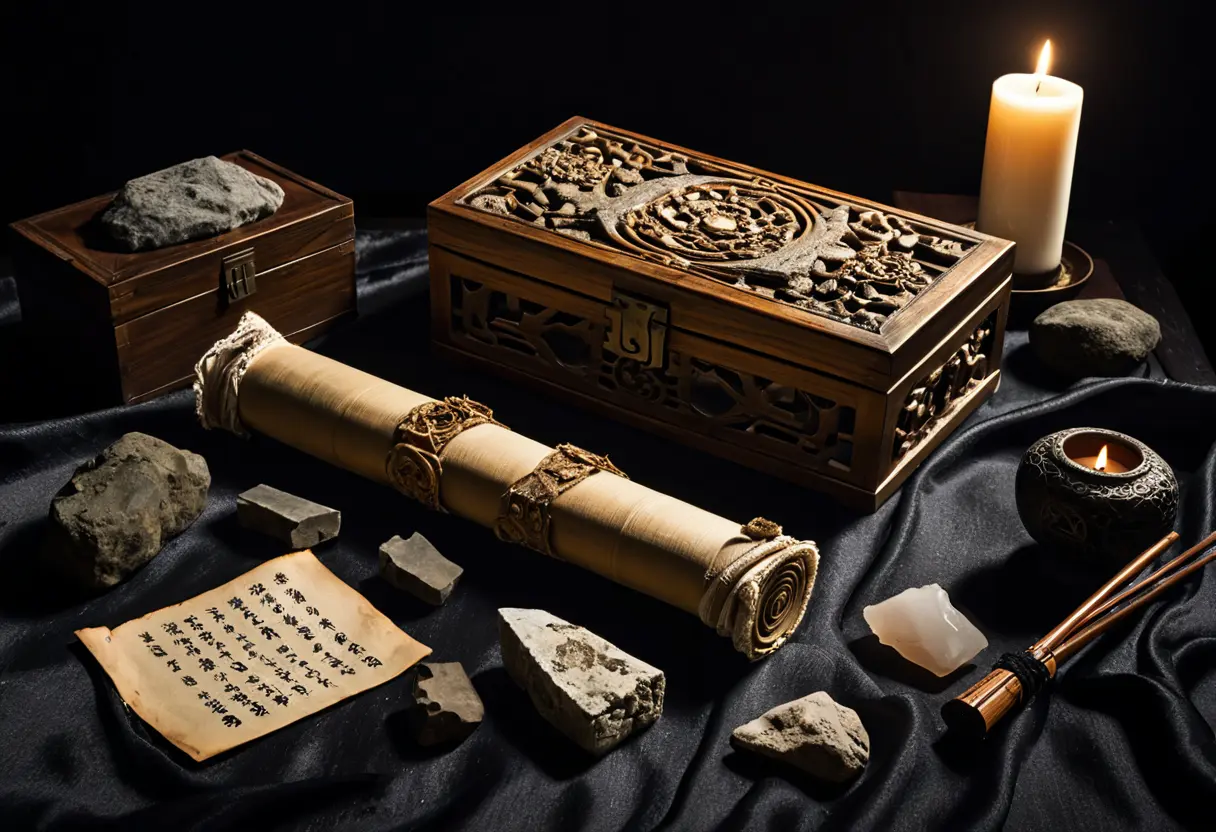
The Blade of Words
In the realm of cursed folklore, the most dangerous act is “knowing.”
To read a certain poem, to understand the construction of a certain box, or to speak the name of a certain monster—in that instant, the circuit of the curse is connected. You are forced into the role of a character in the narrative: specifically, the role of the tragic victim.
When you examine the records within this archive, do not overconfidently assume they are mere ink stains or sequences of digital data. When the story finds you, the curse has already begun.
[!IMPORTANT]
The records in this section are intended for the purpose of conceptual “investigation” only. We explicitly state here that indulging in excessive curiosity toward specific cursed objects may exceed the scope of the “Safe Horror Experience” recommended by this site.
Featured Archives
The most infamous modern taboo. Investigating the puzzle boxes woven from social discrimination and children’s blood.
The classic masterpiece of wish-gone-wrong. A chilling study on the cold mathematics of luck and fate.
A two-faced mummy discovered in a temple’s demolition. Unraveling the ritualistic weapon designed to destabilize reality.
The Catalog of the Cursed *Sessho-seki: The Lethal Miasma : The stone remains of the Nine-Tailed Fox in Nasu. *Tomino’s Hell: The Forbidden Poem : Investigating the lethal rhythm of the spoken word. *The Origins of Cursed Objects : How legends bridge the gap between imagination and physical reality.