The Takenouchi Documents: Japan's Forbidden Hyper-History
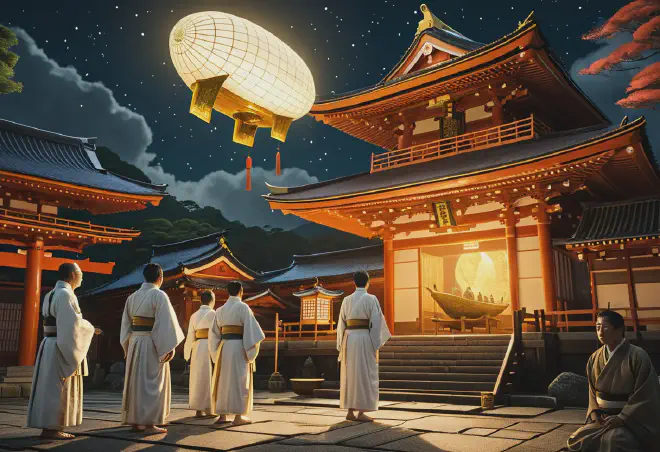
Ancient Sky Boats: Sovereignty of the Clouds
In the hyper-history of the Takenouchi Documents, ancient Japan was not an isolated island but the heart of a “Global Empire” that governed all humanity. The key to this global reach was the Ame-no-Ukifune or “Sky Boats.”
These advanced flight devices allowed the Emperors to travel across the globe, bringing civilization and laws to every corner of the Earth. Modern occultists often interpret these as ancient UFOs, linking the Japanese documents to the broader Global Ancient Astronaut theory. According to the text, the five races of the world (white, black, red, blue, and yellow) are all brothers, branching out from the original Japanese divine lineage.

The Saints in Japan: Moses and Jesus
The most controversial and enduring claims of the Takenouchi Documents involve the arrival of Western religious leaders in Japan during their “lost years.” *The Ten Commandments : Moses is said to have stayed in Japan for 40 days, eventually receiving the Ten Commandments from the Japanese Emperor. The shrine in Ibaraki still claims to possess the “Stone of the Ten Commandments” as proof. *The Tomb of Christ : According to the text, Jesus Christ first came to Japan at age 21 to study theology for 12 years. After returning to Judea, it was not Jesus but his younger brother, Isukiri, who was crucified. The “true” Jesus fled back to Japan, settled in the village of Herai (now Shingo Village) in Aomori Prefecture, married a local woman, and lived to the age of 106.
To this day, Shingo Village hosts a “Tomb of Christ,” where annual festivals are held—a strange cultural pocket where pseudo-history has dissolved into genuine local tradition.
The Passion of the “Gishi”
From the perspective of academic history and linguistics, the Takenouchi Documents are definitively recognized as a modern fabrication . The Kamigyo script is based on modern phonetic systems, and the underlying ideology reflects the intense Japanese nationalism of the early 20th century.
However, the “Gishi” (pseudo-history) endures because it speaks to a deep, collective longing. In an era where Japan was struggling to find its place against Western dominance, the Takenouchi Documents provided a切実 (desperate) fantasy: that Japan was not the student of the world, but its source. From the sunken continent of Mu to the secret tombs of the prophets, it remains a testament to the power of myth to shield a nation’s pride.