The Voynich Manuscript: The Unbreakable Cipher of an Unknown Realm
The Weight of the Authentic
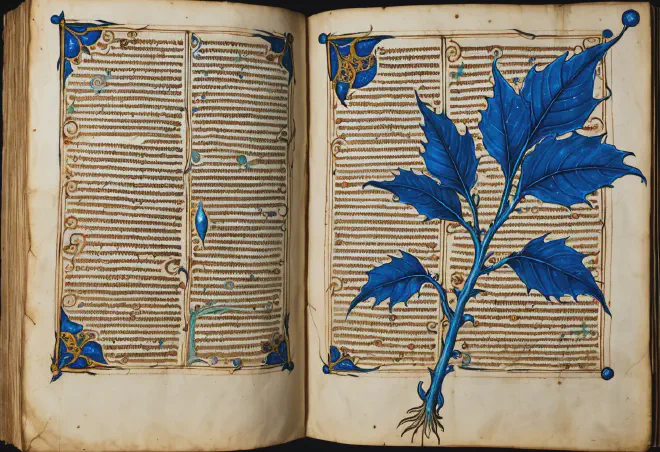
The Voynich Manuscript cannot be dismissed as a modern forgery. Radiocarbon dating has confirmed that the vellum was produced in the early 15th century (between 1404 and 1438). This means that six centuries ago, someone invested a staggering amount of time and expensive materials to create a 240-page book written in a language that officially does not exist.
Sections of a Botanical Hallucination
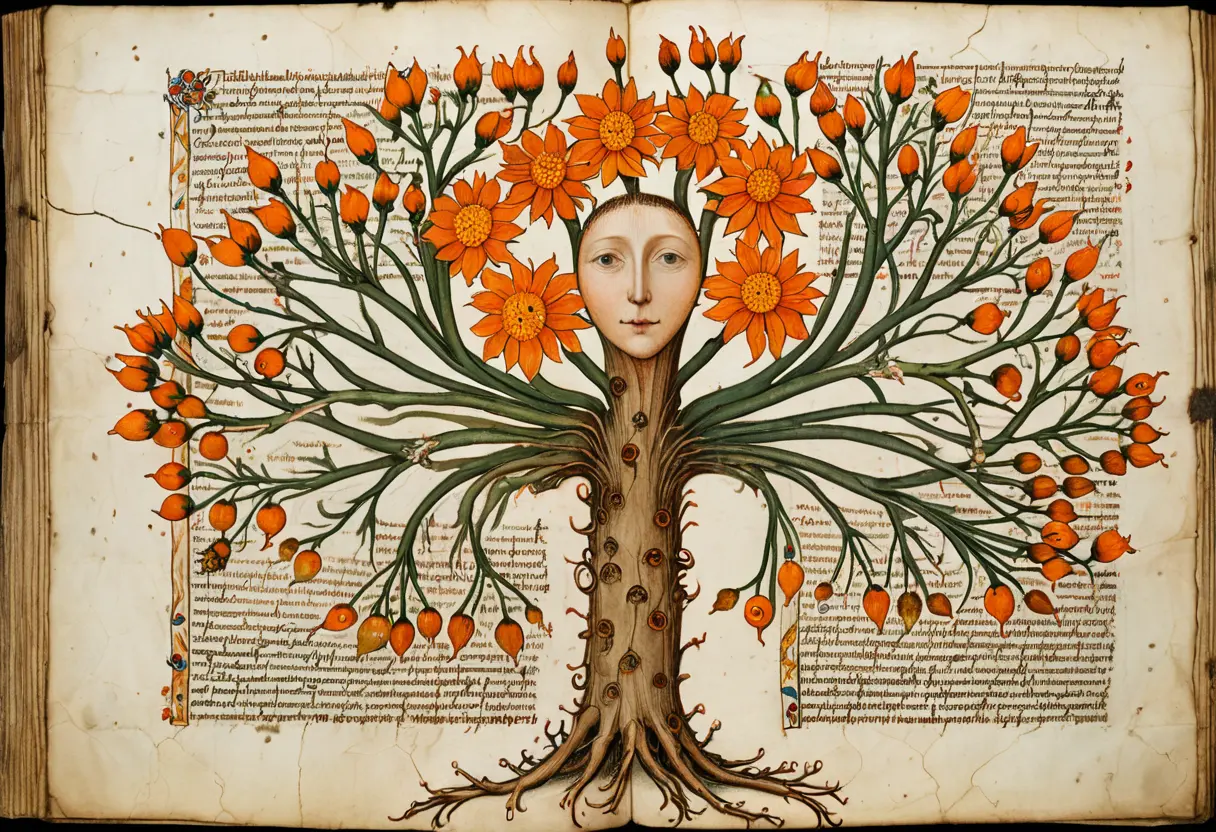
The manuscript is divided into several “chapters” based on its surreal illustrations: *The Botany Section : Precision-drawn plants with unnaturally twisted roots and leaves. Despite their detail, none of these species correspond to any known flora on Earth. *The Balneological Section : The most bizarre portion. It depicts numerous nude women bathing in a complex system of interconnecting pipes and tubs filled with a mysterious green liquid. *The Astronomical/Cosmological Section : Elaborate circular diagrams reminiscent of the zodiac, but with star clusters and celestial movements that diverge from known astronomy.
Language or Elaborate Hoax? Zipf’s Law
For decades, many scholars argued that the book was a “sophisticated hoax”—meaningless babble designed to defraud wealthy collectors. However, statistical linguistics has shattered this theory.
When the frequency of words in the Voynich script is analyzed, it perfectly obeys Zipf’s Law . This mathematical rule states that in all natural human languages (from English to Japanese), the frequency of any word is inversely proportional to its rank in the frequency table. If the manuscript were gibberish, it would not possess this perfect “natural flux.” The data suggests that underneath the alien script lies a highly structured, coherent language—we simply lack the key.
The AI Frontier: Hunting for Anagrams
In recent years, Artificial Intelligence has taken up the mantle. In 2018, researchers used AI to suggest that the manuscript might be a series of Hebrew anagrams. While some words like “light,” “air,” and “farmer” were tentatively identified, the AI failed to produce a coherent, consistent narrative.
Whether it is a “lost Romance language shortcut,” a “constructed artificial tongue,” or an extremely advanced form of steganography (hidden meaning), the manuscript remains the world’s most elegant locked door.
The Threshold of the Abyss
Why does the Voynich Manuscript matter? It matters because it forces us to ask: Is it unreadable because we haven’t found the algorithm, or because it was never meant to “communicate” in the way we understand?
If the book were decoded tomorrow, would we find a panacea for all diseases, a map to a parallel world, or merely the magnificent “play” of a solitary, obsessive genius? For now, the 600-year silence remains the loudest challenge in the annals of history.