The Yonaguni Monument: The Sunken Fortress and the Battle with Nature
Professor Kimura’s Passion: The 10,000-Year-Old City
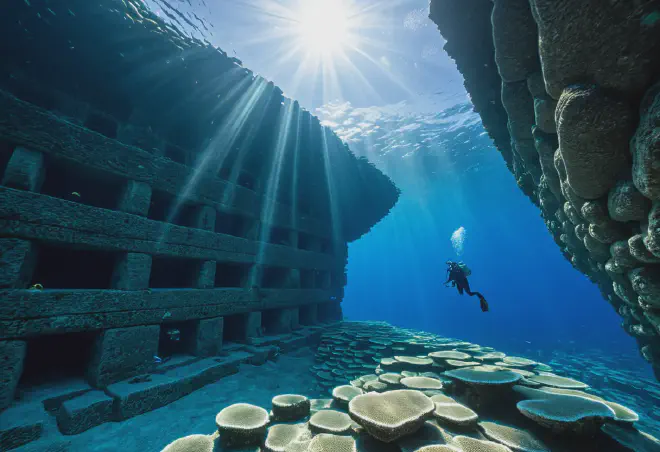
Professor Masaaki Kimura of the University of the Ryukyus has dedicated his career to proving the structure is an “Ancient Sunken City.” Through hundreds of dives, Kimura has documented what he believes are clear signs of human intervention: drainage channels, post-holes for supporting buildings, entrances to temples, and even a relief carved in the shape of a turtle. His theory posits that during the last Ice Age—some 10,000 years ago when the Ryukyu Islands were still connected to mainland Asia—this was a thriving coastal center. This hypothesis resonates deeply with the legend of the Continent of Mu , the mythical sunken empire of the Pacific.
The Geological Rebuttal: Nature as the Architect
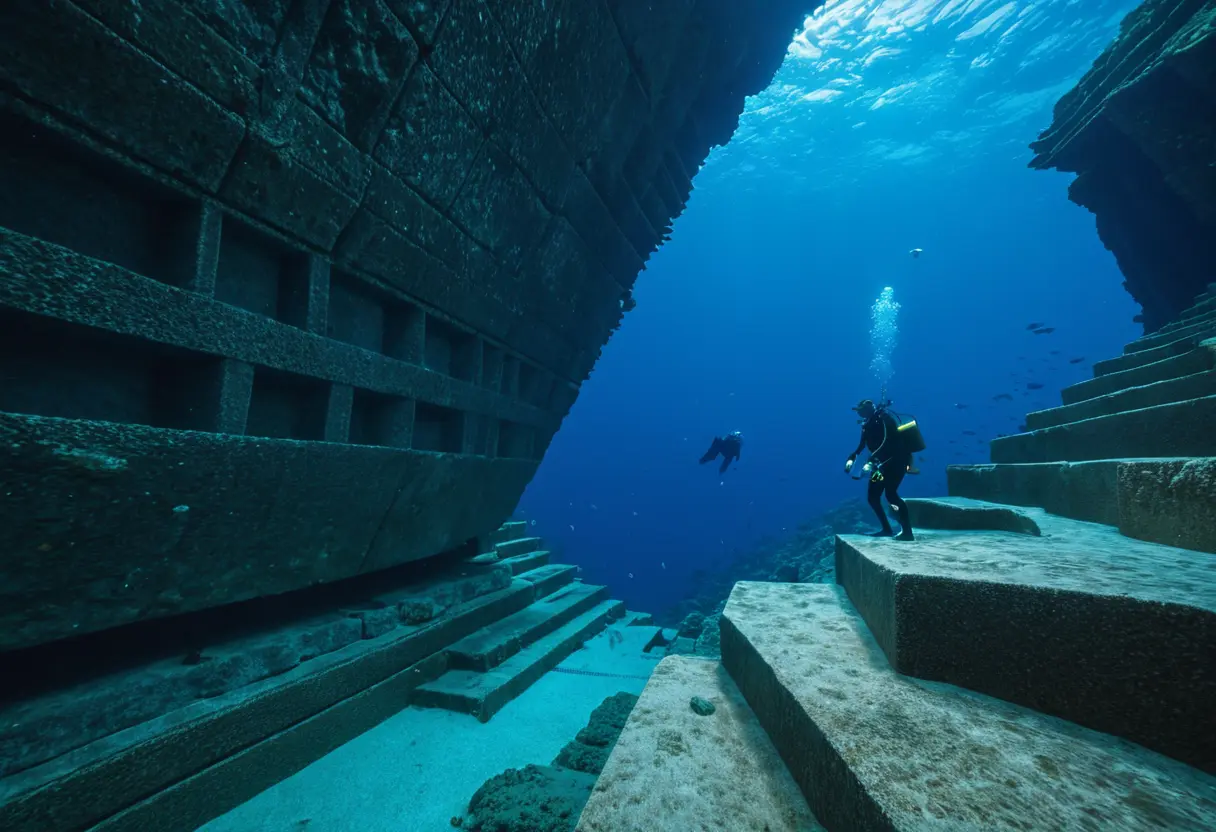
On the opposing side of the debate are geologists like Robert Schoch of Boston University. They argue that the monument is a result of “Natural Jointing” (Tabular Jointing) .
The rocks around Yonaguni are primarily sandstone, which naturally tends to fracture in straight, perpendicular lines. Combined with the island’s intense tectonic activity and powerful ocean currents, Schoch argues that nature alone is capable of sculpting these seemingly “unnatural” shapes over thousands of years of erosion. From this perspective, the “post-holes” are just potholes formed by swirling rocks, and the “drainage channels” are simply natural faults in the stone.
The Cross-Point of Civilization: A Third Path?
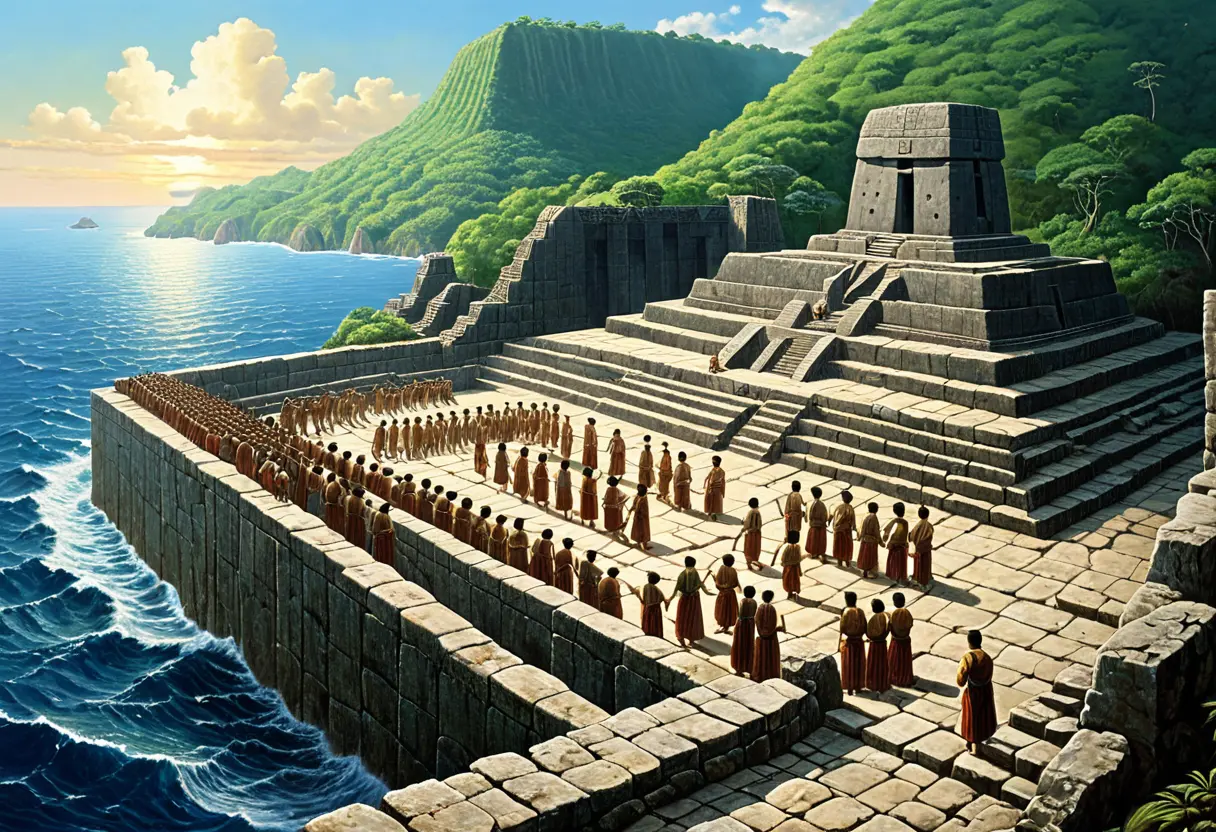
Could the answer lie somewhere in the middle? A “Hybrid Theory” suggests that while the base formation may be natural, prehistoric people may have “modified” the site—quarrying it, smoothing the terraces, and using it as a sacred altar or a coastal fort.
Similar sharp-angled formations can be seen at “Sanninu-dai” on the dry land of Yonaguni, indicating that the island’s unique geology was likely a source of spiritual awe for ancient inhabitants. To them, the rock was already holy; they simply gave it a human silhouette.
The Sanctity of the Azure Silence
Currently, the Japanese government does not recognize the Yonaguni Monument as a “Cultural Asset,” citing a lack of definitive evidence for human construction. Yet, for the divers who visit the site, the sheer presence of the structure—its massive scale and the eerie regularity of its steps—defies a purely scientific dismissal.
Whether it is a temple of Mu or a masterpiece of natural erosion, Yonaguni remains one of the last sanctuaries of “Romantic Mystery”—a place where the boundary between the earth’s will and human memory remains forever blurred behind a veil of deep, azure water.