The Homunculus: Creating Life in the Shadow of God
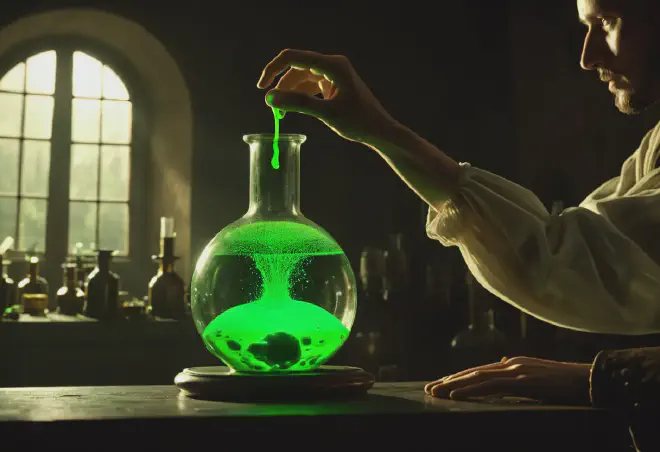
Paracelsus’ Terrifying Prescription
The legend of the Homunculus reached its peak in the 16th century through the writings of Paracelsus , the Swiss physician and alchemist. In his work De Natura Rerum, he left a recipe that remains one of the most bizarre and haunting “scientific” protocols in history: *Putrefaction and Incubation : Seal human semen in a flask and bury it in horse manure for forty days to provide steady heat. *Nourishment of Blood : Once a tiny, transparent humanoid form begins to appear, nourish it daily with human blood for forty weeks while maintaining a strictly “human-body” temperature.
The being that supposedly emerged was said to possess all the wisdom of an adult, the power of prophecy, and an innate understanding of the mysteries of the universe—all while remaining no larger than a human hand.

Hybris and the Glass Boundary
Despite their vast intelligence, the Homunculus had a tragic limitation: they could never survive outside the glass boundary of their flask. They were fatherless, motherless, and—some argued—soul-less.
This image of the “Created Intellectual” was famously explored in Goethe’s ‘Faust’ . The Homunculus in the second part of the play is a brilliant, disembodied mind that yearns for physical existence, only to shatter its glass home and dissolve into the primordial sea. It serves as a stark warning of the Hybris —the arrogance of man attempting to manipulate the fundamental laws of nature without understanding the emotional or spiritual consequences.
From Alchemy to AI: The Modern Flask
The dream of the medieval alchemists has not vanished; it has merely changed its vessel. Today, the “Homunculus” exists in the form of Cloning, Genetic Engineering, and Artificial Intelligence (AI). When we ask if a machine can have a soul, or if a lab-grown entity can be called “alive,” we are asking the same questions that kept Paracelsus awake in his laboratory. The Homunculus is the mirror into which we project our deepest hopes for the future and our most primal fears of playing God.

The Eternal Obsession
The Homunculus reminds us that the quest to define life is as ancient as it is dangerous. Whether made of blood and glass or code and silicon, the “Little Man” continues to watch us from within its transparent prison, waiting for us to find the key to the glass.